


Nature needs YOUR land ethic!
Stay connected through our down-to-earth e-news.

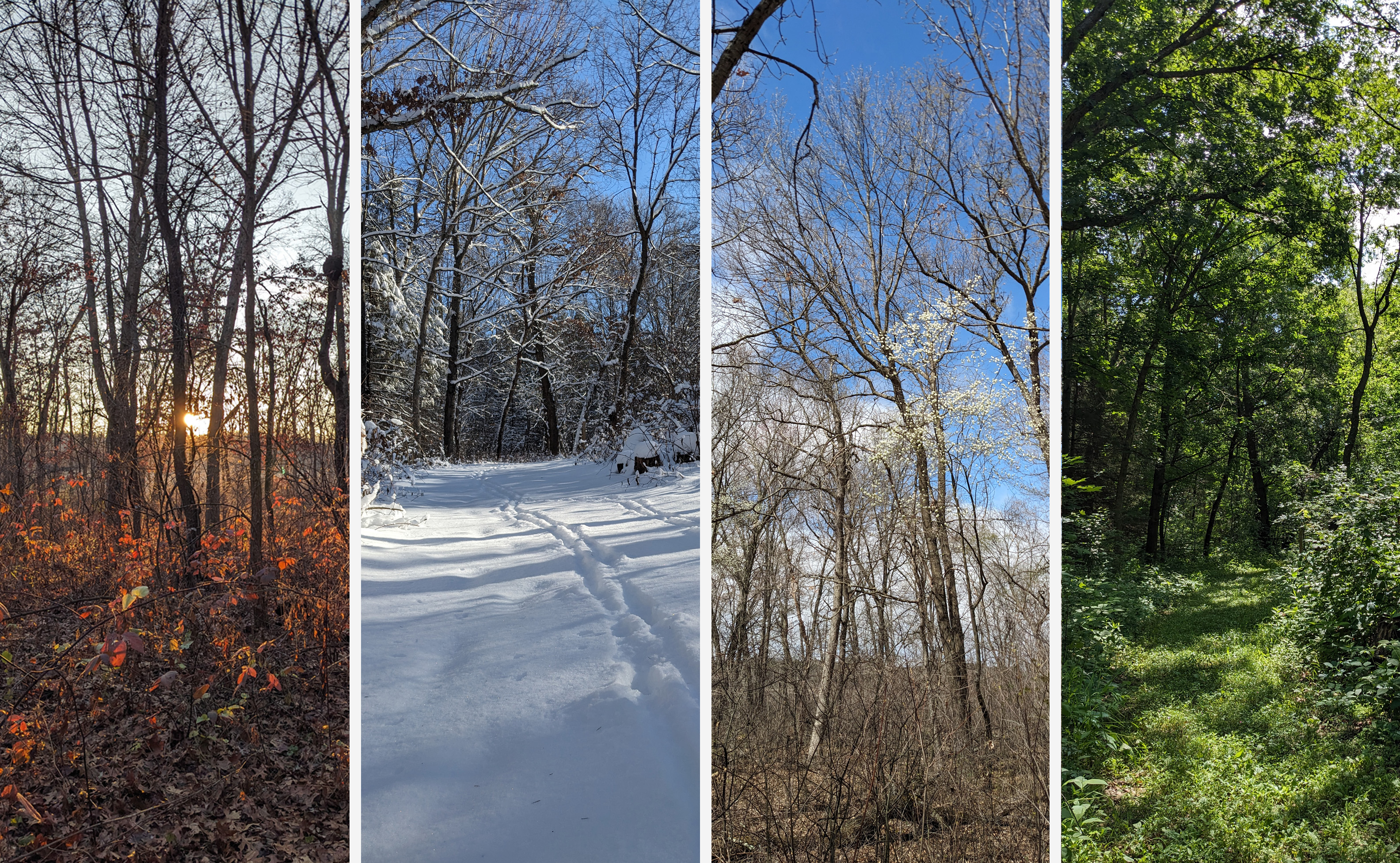
My year of walking began in mid-November.
An unconventional time for a new year’s-type resolution, and some might balk at the season I chose as my starting point. Why not spring, when you can see the world being born again? Why not summer, when the woods are lush and full of birdsong? Why not earlier in fall, even, to at least catch the colors?
The timing wasn’t intentional, really. I was going stir-crazy and I needed to change my office routine, stat. Not to mention, days spent almost entirely inside a building staring at a screen left me feeling disconnected from the natural world I wrote so often about. Like it was some idealized fantasy land, a nice thing to sigh wistfully about before jumping into my next Zoom meeting.
So, I got up and hit the trail.
~ ~ ~

The extra-agitated screaming of blue jays catches my ear on one of my first walks; I look up just in time to see a large, bird-like form slice through the barren trees. An owl. Pure chance to even glimpse such a majestic creature, but that sighting dangles over me like a treasure every time I go out, each time I hear the jays’ squalling. But my gaze can’t point skyward all the time—I might miss a young buck, stock-still on the path ahead, backlit by evening glow and warily eyeing me.
I imprint on late fall’s leaf-littered trails, the amber spill of golden hour light in the afternoon, the bugling of cranes in the sky. This honeyed season teaches me to see the different shades of oak leaves, not merely brown, but a dozen or more distinct gradations: russet, caramel, bronze, toffee; ochre, cinnamon, burnt sienna, chestnut. I learn to watch for deer (and owls) and listen for woodpeckers. To adjust to the oncoming cold.
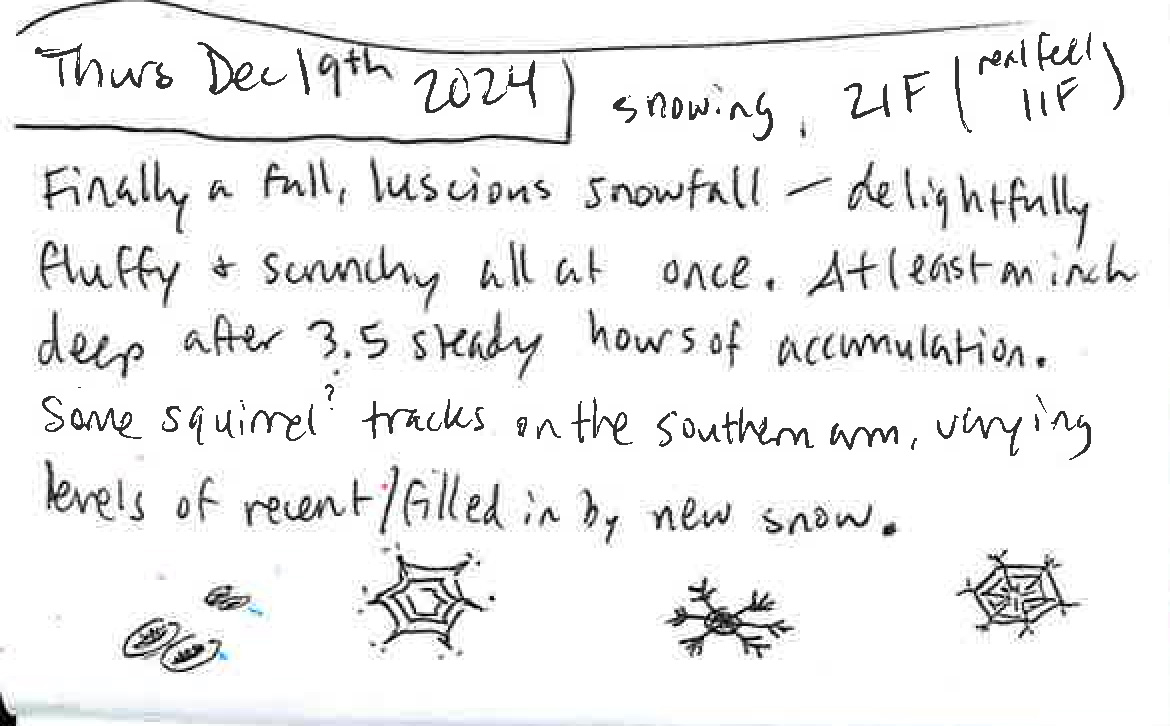
Snow paradoxically unveils an entirely new world. Now I can tell who’s been where, long after they’ve gone. The bounding prints of squirrel or rabbit; the tail trails of mice. Deer leave “double rail ski lines in their wake,” and after seeing the tracks often enough, I notice that their hooves seem to drag in the front, as they lift them (compared to human tracks, which drag in the back as we put our feet down). Is this a characteristic of all quadrupeds? I wonder, noting the same pattern on a set of canid tracks.
Light “patchy” dustings of white leave the trail “marbled,” while a thick cover might eventually end up “splotched with craters like the surface of the moon.” The texture underfoot varies with each fluctuation in temperature: “alternately crackly on the surface or weirdly sticky” during a 40+-degree thaw; “delightfully fluffy & scrunchy” after a fresh accumulation. Trudging in the snow day after day (especially with a good few inches’ worth of cover and a relatively cold stretch), I reflect that “walking in old footprints is an act of re-membering a previous gait, state of mind, pace, attention or distraction; whether I stretched far, legs long, or stuttered my steps; where I stumbled, slipped, caught myself; if I veered off into the white to see closer, snap a picture.” Or, in simpler terms, I’m “scrunching the same old (very not ergonomic) trails.”

I delight in the cold, as ravenous for its prickle on my skin as I had been for November’s fallen leaves. “Let [it] burn in the hollows of my eyes, ache through my teeth.” Keeping my walk indoors for a wind chill warning nearly drives me to madness, and I’m relieved to break out once it’s warmed to a whopping zero degrees F. A neck gaiter and hand warmers make the difference on the coldest days—and following my instinct to “pivot toward the sun.”
~ ~ ~

I like to think I befriended the red-headed woodpecker that lives out in the savanna, but he might see it as more of an unwanted parasocial relationship. I’m always excited to see a glimpse of his shining scarlet head, a black-and-white swoop of wings as he alights on a snag; always stop in my tracks if a faint chirrup tickles my ear from afar. “Reddy!” I call out gleefully (I've always been creative when nicknaming animals—see also: every lizard I ever dubbed “Lizzy”). To semi-regularly see this priority species out in our Important Bird Area, a superstar benefiting from our stewardship and restoration of oak savannas—it’s like having backstage passes to meet a celebrity, even if said celebrity doesn’t have much interest in his doting fans.
There are plenty of other acquaintanceships forged on the trail. Lady and Mr. Cardinal, ever-chirping and occasionally spotted as a flash of red through the brush. The black squirrel. The gaggle of turkeys, a rare gem I go wild at the sight of. What I could swear is the same trio of deer, startled every time I stumble upon them—tails flashing white, hooves pounding the earth as they flee. A close encounter with a titmouse, the bird whose call for some baffling reason I always misidentify as a cardinal, or a chickadee, until this little spike-haired bird, not 10 feet away in the branches of a pine tree, looks me right in the eye so there’s no mistaking it. I spook a painted turtle back into its shell coming around a bend in the trail, freeze in standoff with a raccoon, look up a few times and catch the elusive barred owl slicing silently through the trees.

It’s only a sampling of the critters I’ve run into, and I have to wonder “what creatures might be watching me pass by when I didn't/couldn't even perceive their presence.” Are they people-watching as much as I’ve been wildlife-watching?
~ ~ ~
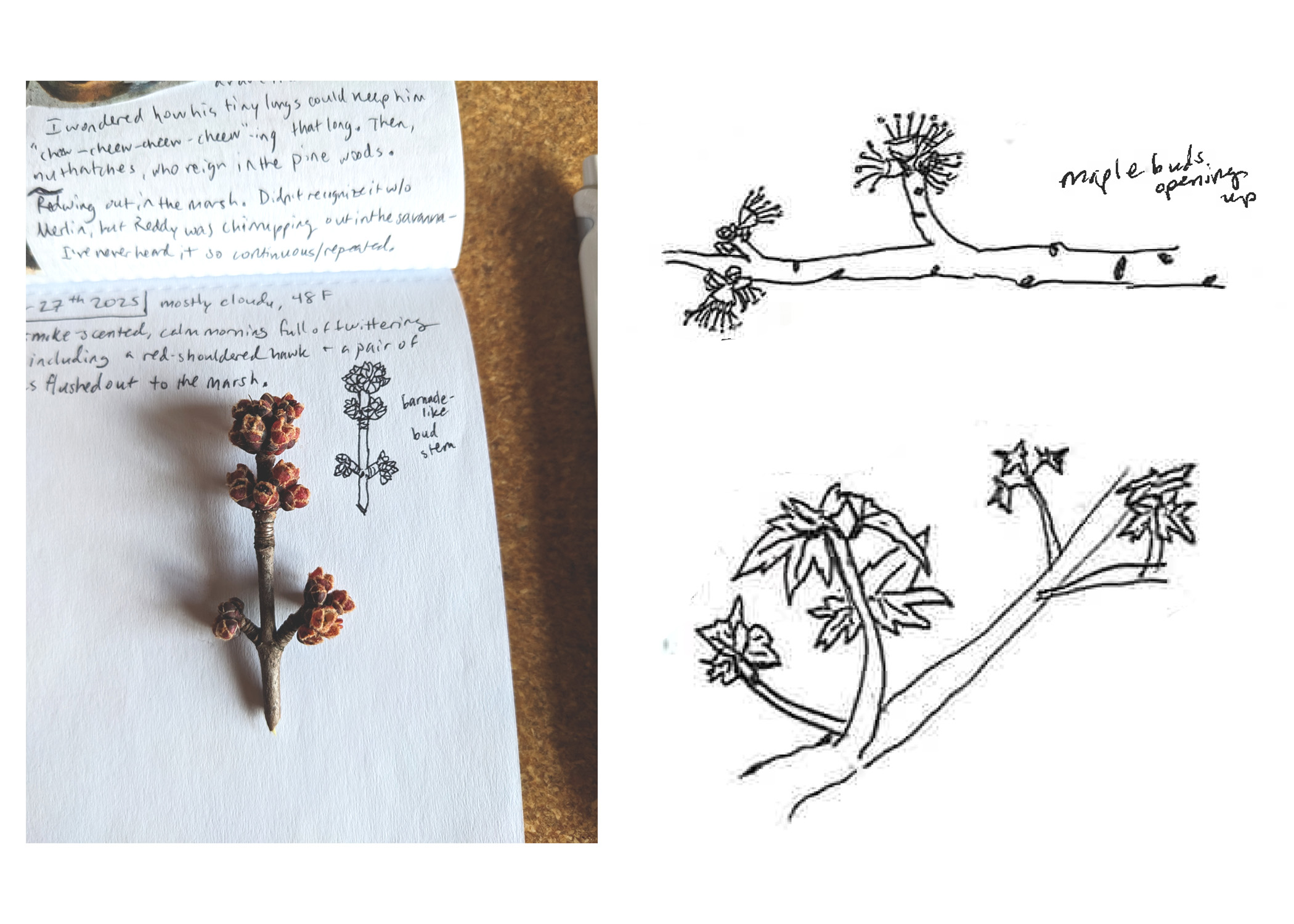
Spring. Awakening. Await-ening. The anticipation of firsts: first towhee back from its wintering grounds; first buds opening on a maple tree; first frogs calling from the marsh. I'm “giddy & smiling,” attuned to everything, ecstatic to discover something that wasn’t there the day before. But it’s not just the start points; it’s beginning as a verb—the act of/active unfolding, each change a new brushstroke on the landscape, layering and adding to this living work of art.
The woods explode with growth, changing practically by the hour, until they’re a jungle I hardly recognize. “Greened & lushed up… Understory just keeps getting taller,” I write on June 2nd, returned from a long trip away. A path I’ve walked for so many months is suddenly unfamiliar as lush vegetation spills and arcs over the trail’s edges, obscures the bend ahead, hides the birds in symphony among the trees. My rusty, uncertain memory tries to remember the songs, helped along by Merlin, the sound ID app always at the ready in my pocket. Cowbirds and yellow warblers, field sparrows and flycatchers, the American robin (I swear, it sounds like a different bird every time). And there are plenty of new ones I learn, too: blue-gray gnatcatcher, ovenbird, wood thrush, ruby- and golden-crowned kinglets.

Layered beneath the birdsong, the “steady, shimmery-edged insect drone” is the beating heart of summer. Grasshoppers spring forth and scatter at my feet like popcorn; butterflies flit and dance through the forest’s dappled light. The air is thick, suffocatingly so as I suit up against the blood-sucking entourage that accompanies me through the woods. There’s a mention of this particular misery in nearly every entry. “CAN’T HEAR THRU THE BUZZING!” “Kinda sucks that it’s all I can do to stave off the mosquitoes, so I can hardly stop to use Merlin or snap a pic.” “Oh my god, she’s got her proboscis stuck in there!” Even so, it’s not enough to keep me from venturing out (and, occasionally, to try to take a picture).
Thanks largely to the mycology walk I joined during BioBlitz, I become obsessed with fungi. I think I’ve always thought mushrooms were interesting, but now I’m riveted. Into the wetter second half of summer, there are new finds popping up on the forest floor near daily—and just as soon as I effusively greet them, marvel at their arrival, they’re gone, the next day crushed or broken-off or eaten by some creature. It’s an odd exercise in non-attachment. I learn to sink into that initial moment, the first viewing, soak it in (take a photo, as mosquito conditions allow). Like Leopold and his painting river. Tomorrow the picture will have changed completely. Unlike Leopold, though, I come back each day, not because I think I can get a second view, but because I know there will be something entirely new to see.

~ ~ ~
I am by no means the only human out there. Occasionally, I invite a friend or coworker to join one of my loops, our amiable rants interrupted as we point out a snake in the leaf litter, or fall silent, heads cocked, to identify a bird call. I wonder at someone’s footprints in the snow, and they wonder at mine, and later we share these wonderings over dinner.
For the most part, though, I go to the woods to escape—if briefly—my fellow humans. The few times I cross paths with a stranger activate a primal fear pathway. Like a deer, I freeze mid-step, adrenaline surging through my veins, senses heightened to buzzing acuity. Pathologically misplaced, still it’s an inescapable reminder of my animal-ness, a kinship evoking anything but warm and fuzzies.
Even the “people were here” signs hit me with a jolt, especially the unmistakable traces of the stewardship crew: machine tracks through sand or snow; the abrupt gouge of a trail’s edge. If I’m being honest, it cuts me, too, like someone grated off a piece of my skin. Sometimes, the “why” of their task is obvious enough—welcome, even, if I do grumblingly lick my wounds as I adjust to the change—but other times, I’m left only with the shard of grief, the inexplicability, running circles around my own helplessness, howling.
~ ~ ~
“The unquenchable thirst for leaves—pockets full of leaves—I try to leave them, but how can I resist such beauty?” -entry from Sep 17th
Each new color is like a drop of paint that gradually spills across the canvas of foliage. Maples turn yellow, orange, peach; oaks go rusty red. Leaves “[shower] down through the canopy, crackling like a sizzling pan, like applause.” The forest floor turns mosaic, with a soft crunch under every step. I turn this ground fixation into a learning game, “looking down, IDing the leaves, then looking up to confirm the trees they came from.” The pointed oval shagbark hickory leaves are nearly as big as my foot, black cherry the much smaller, fit-in-my-palm replicas. I’m tripped up by what I think is a cottonwood, but turns out to be linden. I can’t tell one oak from the next but love them all. Maples are the most likely to be frozen in “multicolored mid-transition,” scarlet bleeding into black, yellow to fiery orange. I can’t help gathering my favorites in my pockets. Without intending it, my office becomes something of a leaf museum, specimens pinned to the wall, laminated; for a while, there’s a gradient of cherry carefully piled in one corner of my desk, until a windy day in November when I “release [them] back onto the breeze.”

The air cools. A familiar chittering tells me the juncos have returned—I’m obsessed with their white underbellies and tiny pink beaks. By mid-October, with the mosquitoes finally gone, I can relinquish the head net, “my ears… uncovered & open in a way they haven’t been for months.” Meadowhawk dragonflies hover, blink-and-you-miss-them flashes of red bodies and shimmering wings. And, of course, the cranes: their cries echo from the river, tumble down from the skies. Their gathering here a moment when rest and restlessness collide.
~ ~ ~
The notepad I used for this experiment lasted through Christmas Day, 2025. I figured it was as good an ending point as any—running out of pages. I kept walking, now freed of the self-imposed pressure to write or sketch about my outings, but it only felt freeing for a week or two before I itched for the pen again. (I mean, how could I not log seeing the world’s tiniest and cutest golden-crowned kinglet with my best friend on New Year’s Day? That’s borderline criminal.)
It could just be the collector and cataloger in me, that I can’t stop jotting things down; that when I spot a “first” of the season, or am struck for the millionth time by how adorable nuthatches are, I need somewhere to gush about it. I guess I’m like Leopold, in that way, and over the last year I got closer to seeing the land as he did—getting down on the ground in rapture of a flower (or, in my case, a fungus), stepping back to marvel at whole scene. It doesn’t take much to make that little bit of space. Just a short walk out the office door did it for me. No corner of nature is too small if you can feel the earth under your feet. “I wonder,” I wrote in that final* Christmas entry, “if [we] might feel some great planetary pulse if [we] stand there still long enough…”
Grant yourself that moment to step outside, to stand still—and you might just feel that pulse, too.
Author’s note: The title is an homage of sorts to one of my favorite musicians, Italian pianist and composer Ludovico Einaudi, who produced a series of albums entitled “Seven Days Walking” that were inspired by winter walks in the Alps, following the same trails over and over again.


.svg)


The Aldo Leopold Foundation was founded in 1982 with a mission to foster the Land Ethic® through the legacy of Aldo Leopold, awakening an ecological conscience in people throughout the world.
"Land Ethic®" is a registered service mark of the Aldo Leopold Foundation, to protect against egregious and/or profane use.


Stay connected through our down-to-earth e-news.