


Nature needs YOUR land ethic!
Stay connected through our down-to-earth e-news.

Teach your children the value of a dollar. This common philosophy of economics is so ubiquitous that we need not wonder about its meaning. As the famous economist Milton Friedman put it, “Nobody spends somebody else’s money as carefully as he spends his own.” Aldo Leopold asserted a similar belief with respect to how we value wildlife. To paraphrase: if we disengage, disregard, and avoid our responsibilities to the land and wildlife, then we will likely spend it as we would someone else’s money. This is especially true of less charismatic or seemingly insignificant species. Though we overlook them as we might a lone penny on the sidewalk, learning to notice and appreciate them can help inform our outlook on how we value all wildlife.
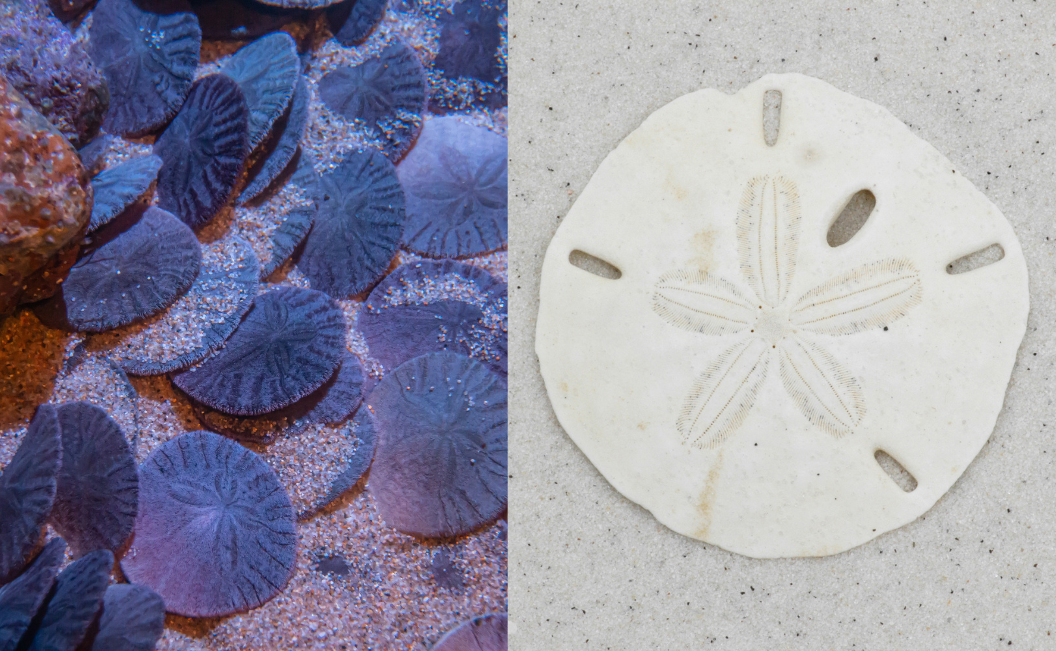
Think for a moment of a sand dollar. A sand dollar is a flat, bottom-dwelling, underwater creature closely related to sea urchins. These filter feeders lie on, or burrow beneath, the sandy seafloor where they feed on plankton, algae, and other kinds of organic debris. By filtering the water and recycling nutrients, they naturally clean the environment around them. In this way, these unassuming creatures in fact play a vital role in the overall health and balance of the entire ecosystem. And this is without mentioning their cultural significance.
The animal’s distinctive mouth parts have acquired an evocative nickname, Aristotle’s Lantern (bearing a resemblance, according to that famous philosopher, to a horn lantern of his era). This amazing organ, with its five-sided jaw sections and its many skeletal and musculature segments, is what the sand dollar uses to scrape, eat, and clean her watery world. At the end of her life—when she too has been scraped, eaten, and cleaned out—her white skeleton with its five-sided flower design, the lantern within it, is carried up from the depths by the tide. This beautiful memento, called a “test,” is a universally prized find among beach combers.
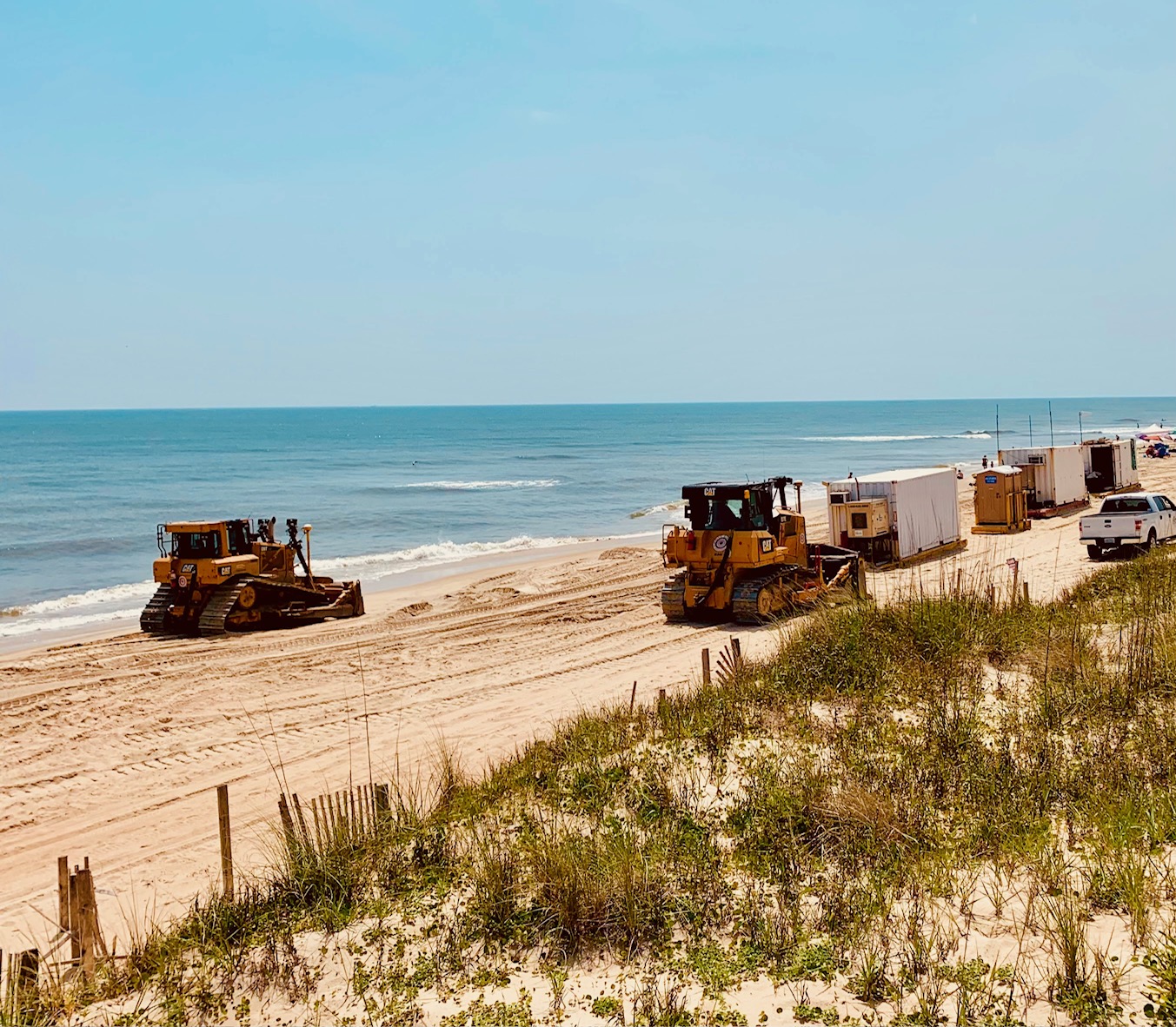
Sadly, this summer, on the Atlantic coast where my family and I own a home, we had little to no chance of coming across a sand dollar test. This was due to the undertaking of a large beach nourishment project by our local municipality. Beach nourishment is a form of coastal engineering where supplemental sand or sediment, pumped or dredged from offshore, is added to existing coastlines. First introduced in the United States in the 1920s, nourishment is frequently undertaken to counteract erosion, and in fact is now the dominant coastal management strategy for sandy beaches along the eastern seaboard and Gulf coasts—and likely to become ever more prevalent in the face of rising sea levels and intensifying storms.
I recently did a deep dive into the ecological effects of nourishment operations along the Atlantic coast. While researching the topic, I read several third-party environmental studies. In every study the researchers presented different angles, all summarized broadly as “weighing the costs.” These costs included the actual work of building back eroded beaches—or not—as well as many other areas of economic consideration. Many of the studies focused on the numbers, primarily the millions and billions in tourism revenue and other real estate investments along the coasts. The ecological costs though, included “the complete removal of sediment” and “direct mortality to the benthic infauna that live in the substrate,” stripping essentially all life on the ocean floor in an up to seven-mile swath. This would obviously impact the ocean-cleaning sand dollar.
In a concluding statement one report said the following:
“There are several factors that must be considered when mitigating beach erosion hazards; including the local and regional beach ecology, economic significance, public and private investments (homes, infrastructure, and businesses), and levels of risk in the face of rising social, environmental, and economic stakes.”
The final verdict: the benefit outweighed the “cost.”
I find this troubling. I am not here to make a statement on the ethics of beach nourishment per se, though I do believe it is doing more harm than good for wildlife and the environment. Substrate-dwelling fauna, such as the sand dollar, that would be directly impacted by dredging or sediment addition are well adapted to the fluid, shifting nature of the seabed and coastline, and even the ongoing erosion that takes place there. It is the desire of humans for permanent construction amid this fluid environment where the challenge arises. I also recognize the nuance, and do not discount for a moment the importance of considering the lives and personal interest of the longtime human residents living along the coast, myself among them. The broader question I am raising is about how we consider the value of wildlife in general.
We often weigh the financial costs of conservation on an unbalanced scale when compared to the environmental costs. It is clear that this type of calculus is difficult, nuanced as previously mentioned, and often controversial. However, if we too freely negate the tangible price paid by wildlife and the environment—which we are meant to manage after all—in favor of broader economic growth, then we are acting as those who would easily spend someone else’s money.
When this happens, we are doing ourselves and the natural world a great disservice. And often those who most readily accept this type of analysis are also those who have never truly learned or fully grasped the value of an ecological dollar—or should I say, the value of a sand dollar.
I personally believe one of the best ways to learn and pass on knowledge, commitment, and responsibility to the land—indeed, to understand the value of a sand dollar and the importance of seemingly less significant creatures—is through responsible, conservation-minded hunting.
First, take the simple concept of where our food comes from. Leopold spoke of “the danger of supposing that breakfast comes from the grocery.” We have become so disconnected from the land that many no longer recognize the true value, even the actual necessity, of it. In his essay, “Wildlife in American Culture,” Leopold eloquently described the role ethical hunting can play in reconnecting us to our ancestral roots of living off the land, and of reminding ourselves that, though we may not realize it, we still do live off the land. Most folks simply take it for granted because their integral responsibility has been stolen by (or freely given over to) the “middleman.”
“…There is value in any experience that reminds us of our dependency on the soil-plant-animal-man food chain, and of the fundamental organization of the biota. Civilization has so cluttered this elemental man-earth relation with gadgets and middlemen that awareness of it is growing dim. We fancy that industry supports us, forgetting what supports industry. Time was when education moved toward soil, not away from it. The nursery jingle about bringing home a rabbit skin to wrap the baby bunting in is one of many reminders in folk-lore that man once hunted to feed and clothe his family.”
I have seen firsthand the difference between my own children’s view on the value of wildlife, its sacredness, and its venerability, contrasted by the view of others who have not practiced any real connection to it. My children have experienced the painstaking efforts and great joys of successfully harvesting a wild animal, the meticulous care for the meat, and the coveted meals that follow. Procuring their food in this way has changed how they see their place in the natural world—no longer just purchasers in a supply chain but links in a chain of dependency, viscerally connected to and reliant on the land. It has also fostered an even greater sense of awe, wonder and understanding of their responsibility towards the special creatures who are still wild, elusive, and precious.

Again, Leopold articulates it so well: “Suffice it to say that by common consent of thinking people, there are cultural values in the sports, customs, and experiences that renew contacts with wild things.” Many of my most memorable and impactful lessons in nature have come when I was afield in pursuit of game, often without ever pulling the trigger or releasing the bowstring.
One such lesson happened on a squirrel-hunting afternoon in a beautiful patch of forest not far from our home. My son had come with me; being quite young at the time, his attention was easily distracted from the main task at hand. We spent much of the afternoon exploring the small wonders of the place, like salamanders in the leaves on the forest floor. We talked about the lifecycle of the salamander, about his changing color phases, and his time spent in the water, on land, then back in the water. We were moving slowly, speaking quietly, and though I was intent on bringing a few edible prizes home in our game bag, my boy was completely content with taking in all the sublime details of the natural world around us.
As the sun began to set, and the low angular rays of fading light pierced the darkening hemlock grove, as if through cracks in an old barn wall, we were startled suddenly by an explosion of movement in the branches above. Silently, as if out of another dimension altogether, a large Barred Owl swooped low, just overhead. In an instant, the owl snatched a squirrel, who was likely hiding from us, off the backside of a nearby tree—then vanished, the squirrel clutched tightly in his talons, as quickly as he had appeared.
In the crepuscular dim, with the rust-colored sky quickly darkening as the earth turned the page on the day, we sat in the soft duff beneath the hemlocks and let the awe of it wash over us. “He’s definitely a better hunter than you, Daddy!” my son quipped. Despite our empty game bag, I couldn’t help but smile. “You’re right, I’ll never be as good a hunter as the owl.” The evening’s priorities had shifted with the first tiny orange salamander my son had noticed, and that was perfectly fine with me. We had meat in the freezer and produce from the garden besides. The escapade had instead provided that spiritual nourishment that we are often lucky to receive when we slow down and engage with nature, not just through witnessing such a dazzling display, but also by inviting us to mindfully attend to the smaller details of the forest and to recognize the magic lying—quite literally—right beneath our feet.
When done ethically, and by applying Leopold’s principles and philosophies, hunting can be one of the most formative ways to experience and embody the value of nature, and to pay those gains forward to the next generation. But of course, there are many other very valid and meaningful ways of doing so. Plant a garden, raise some chickens, go fishing or foraging, spend a day in the woods observing, or beachcomb a serene shoreline in search of the sea’s discarded treasures. Any experience that renews one’s contact with wild things and wild places can inspire awe and admiration, reveal the beautiful complexity of other living beings, and remind us of our place within the broader ecological web of life.
Next time you’re walking along the beach and are lucky enough to find a sand dollar test, pick it up and pause. Dwell for just a moment on how this humble and unassuming creature can play such a key role in maintaining the “integrity, stability, and beauty” of her underwater home—and think of how you can learn to see and appreciate other organisms just like her wherever you live. Perhaps Leopold’s land ethic, along with Aristotle’s Lantern, can illuminate their inherent value and, in so doing, light the way forward, toward a brighter future for all living things.


.svg)


The Aldo Leopold Foundation was founded in 1982 with a mission to foster the Land Ethic® through the legacy of Aldo Leopold, awakening an ecological conscience in people throughout the world.
"Land Ethic®" is a registered service mark of the Aldo Leopold Foundation, to protect against egregious and/or profane use.


Stay connected through our down-to-earth e-news.