


Nature needs YOUR land ethic!
Stay connected through our down-to-earth e-news.

*Adapted from Joanna Dane’s “As Poem is to Mycelium” and “Phenology Friday Playbook”
Hearing their students express their dislike of biology, two Appleton high school teachers wondered what they could do to turn things around. “What are we doing with all of our standards and rubrics, all our assessments and strategies if ultimately, we are teaching our students to hate science?” Their spark of inspiration came from a somewhat unexpected source: a colleague in the English department who shared that she started each class by reading a poem. Why couldn’t they do the same with their students?
Joanna Dane proposed the idea to her co-teacher, Shannon Lang, who balked a little. “‘How about once a week?’ she countered, afraid that reading too many poems to high school freshmen might have the opposite of intended effect.” But… she hadn’t said no.
“And so,” Joanna writes, “it began.”
~
As the seasons turn in the second semester, the classes read Reid McGrath’s “To a Red-Winged Black Bird on the Advent of Spring.” Joanna remembers her own freshman biology teacher explaining why the birds perched and screamed and flashed their red epaulettes. She asks the students if they noticed these birds over the weekend. None have. She pulls up some photos and a video, and a few kids light up with recognition. “Oh, yeah!”
How does the poet describe red-winged blackbirds? she asks the class. What other signs of spring does he mention? Their assignment over the break is to take a photo of a sign of spring that they encounter, which will be included in a class slideshow.
~
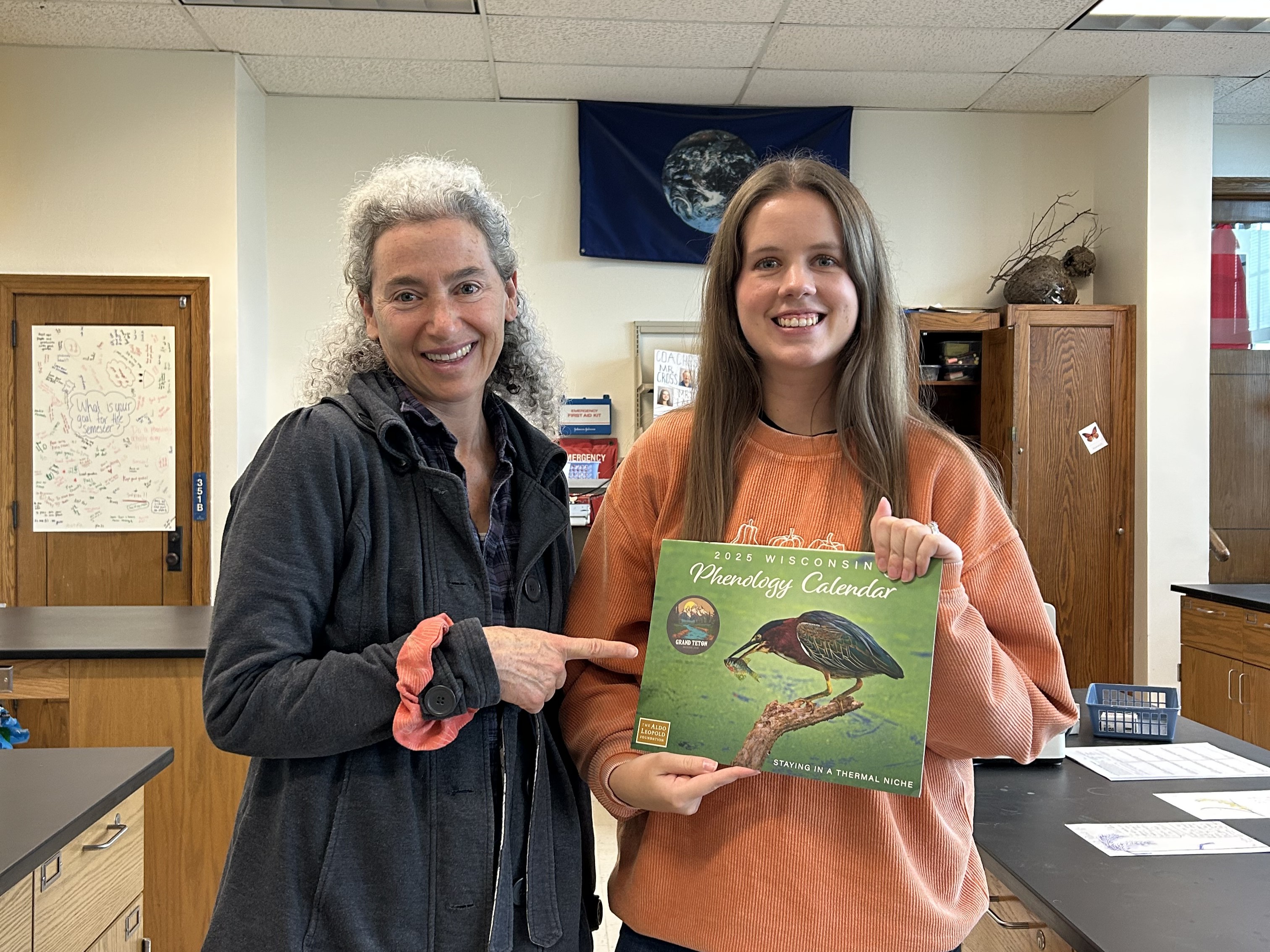
While the students are relaxing over break, the teachers scramble to prepare for their return. The night before classes resume, Joanna looks at the calendar hanging on the fridge—the phenology calendar gifted by her mother-in-law every Christmas—and gets an idea.
Joanna and Shannon photocopy the April spread and pass out pages to the students, telling them to pick a number from a bag, when a student interrupts to ask about the day’s poem.
“I’m shocked that she cares enough to ask,” Joanna writes. “‘Yes, but it’s in prose.’ ‘What’s that?’ ‘In a paragraph, not a poem form.’ ‘When are we going to read a poem poem?’ ‘Next week.’ ‘Okay,’ she says, eyeing me. ‘Promise?’ ‘Promise!’”
The teachers hand out notecards and direct the kids to make a sketch of the natural phenomenon matching the number (date) they picked, plus two to three fun facts. Then they discuss in small groups what they learned about the phenological events expected to happen that week. But of course, one can hardly be introduced to phenology without also being introduced to Leopold—the students also read a short bio on the father of wildlife conservation, then are called on to share what they learned.
“He was born in Iowa?” “He died fighting a fire.” “One of the founders of the Wildlife Society.” “He loved nature.”
The prose poem they’d planned to read was Aldo’s April essay, “Draba,” but they run out of time.
~
The next week, the students rotate through poetry stations at the different lab tables, reading spring haiku out loud to one another. What do they notice? What images do they see? What if they wrote their own poems? “Using the [April spread from the calendar], their notecards, their signs of spring photos, and classic Japanese haiku as inspiration,” the students are instructed to write their own three-line haikus about spring.
Signs of Spring: Class Haiku Poems. Also viewable at this link.
~
Joanna and Shannon were “so delighted by the students’ reactions to the April phenology calendar lesson, that when an opportunity for writing a grant came up, we decided to try to get Wisconsin Phenology Calendars for all our biology students.” The school awarded the grant. When the co-teachers reached out to us at the Aldo Leopold Foundation, we offered a matching grant so the students could get both 2025 and 2026 calendars, covering the entire academic year.
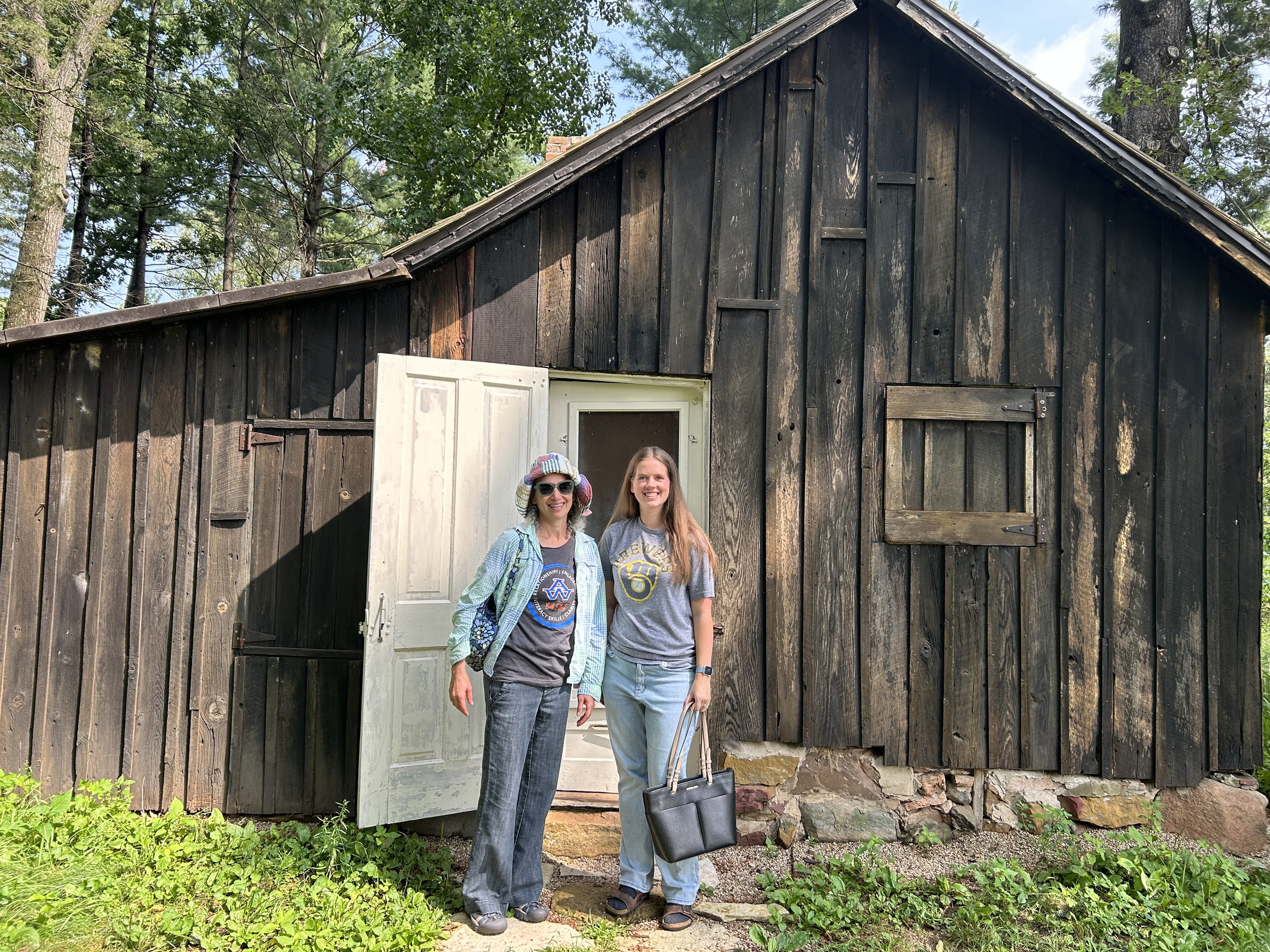
The weekly poetry days had been a hit, so they formulated a plan to regularly incorporate the calendar into their curriculum, too, “which is how Phenology Friday was born.” Joanna and Shannon made the trip down to Baraboo to meet with Leopold Foundation staff, sharing their idea and brainstorming ways to bring Leopold’s legacy of observation into the classroom. Naturally, a visit to the Shack was in order, not least because it marks the place where the Leopold tradition of phenology took root.
~
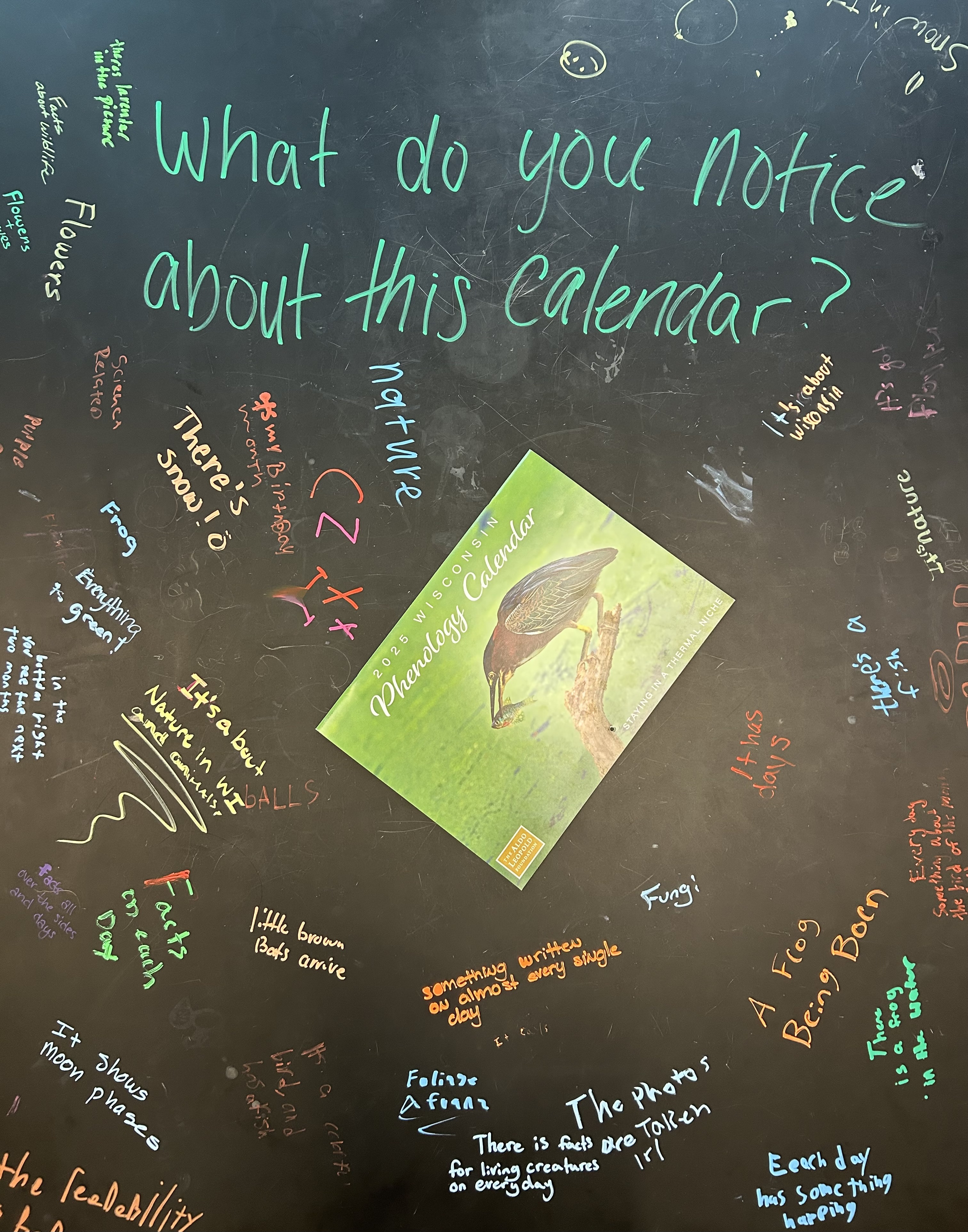
September kicks off a new school year and brings a fresh set of students. The teachers place the phenology calendar at one of the welcome stations, writing on the table in chalk marker: what do you notice about this calendar?
3rd hour takes it as a prompt for discussion. But 6th hour has other ideas. “When I see some students writing on the table at the calendar station, I make a move to stop them because they are supposed to discuss, not write about it.” Something checks her, though, and Joanna simply watches their observations unfold in squiggling color across the table.
The first “Phenology Friday” ends up falling on a Tuesday. The week prior, the classes had read Wendell Berry’s “The Peace of Wild Things” and shared the places in nature that make them feel calm and at peace. “Shannon tells them that our goal is for everyone to find a place in nature that makes them feel peaceful; [and] to help foster connections with the natural world this school year, we explain how we wrote a grant to get each of them a present.”
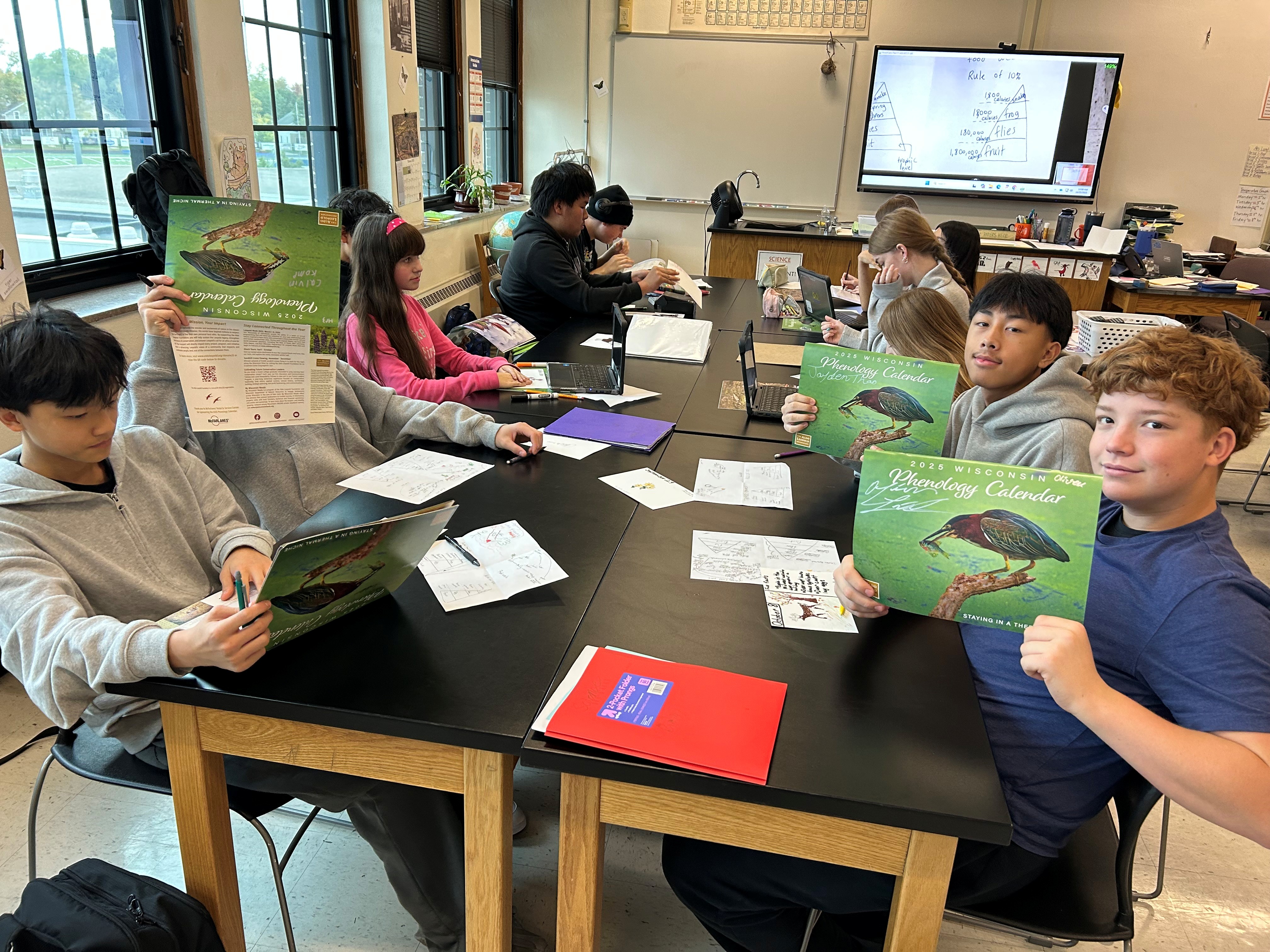
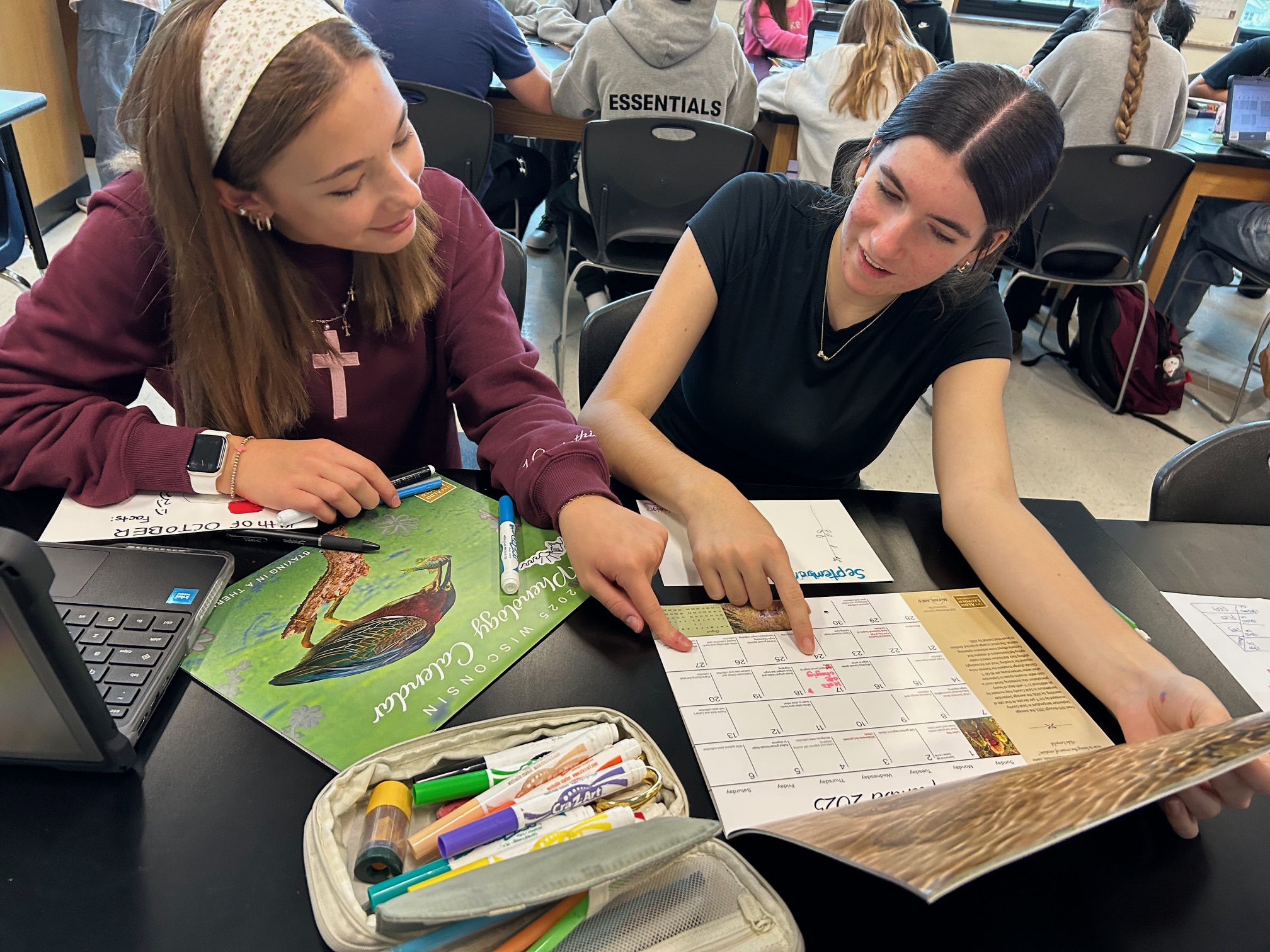
The students tear open the envelopes the moment they get them. “It’s the calendar that was on the table during open house,” one remembers.
The teachers refrain from giving directions, “reminding [themselves] to just observe…. They all seem genuinely curious, bursting into conversation as they flip through the calendar.”
When they find the Aldo Leopold Foundation logo, the teachers ask who’s heard of Leopold (only one kid, who can’t recall anything specific), then tell them “how Aldo Leopold bought a farm outside Baraboo, Wisconsin, with the mission of returning the land to what it once was, with oak woods and prairie. How he and his wife and 5 kids lived together in a tiny shack along with the mice, the mosquitos, the bats. And how hard they worked planting hundreds of trees. And how they always took meticulous notes about everything happening on the land. And how [Nina] carried a guitar and a notebook. And how Aldo wrote an essay about the good oak’s final falling and essays about the land over the course of a year; A Sand County Almanac, now a classic of American nature writing.”
Then the students are directed to personalize their calendars with their names and whatever dates are important to them. Many, of course, note their birthdays. One asks if she can record Chilean Independence Day. Everyone is encouraged to write down things they’ve been noticing and observing in nature recently.
“The leaves are changing?” “And falling!” “The squirrels are running around like crazy with their nuts!” “Yes—write those things on the calendars for this week!”
~
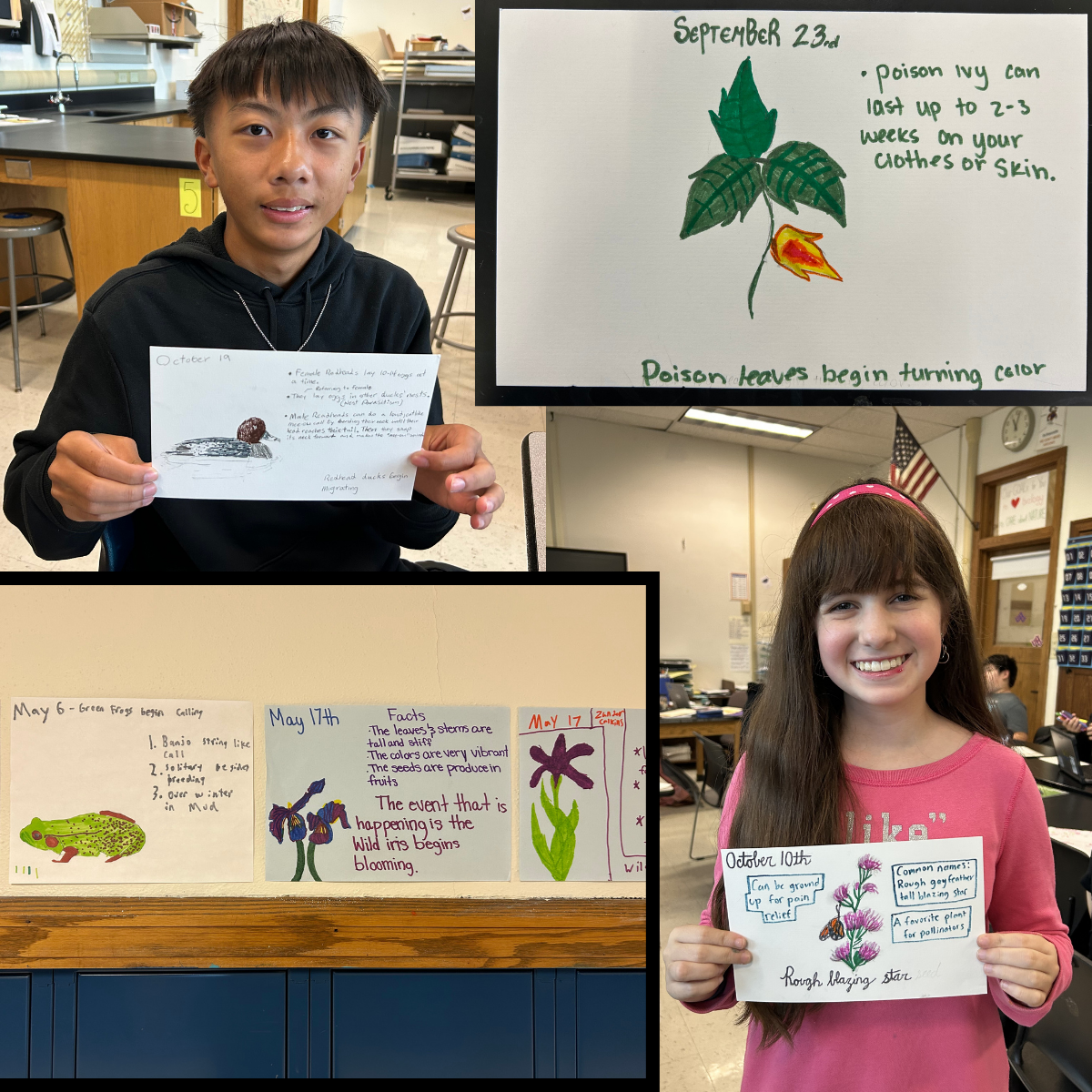
For their next “Phenology Friday,” the teachers have the students pick numbers from a bag that correspond with dates for September and October. As they did in the spring, they’re making phenology cards again!
How to make a Phenology Card:
Write the date big at the top.
At the bottom, write the phenological event for that date.
Draw a picture and list 2-3 fun facts about the organism.
They plan to display them, “so make sure you can read it from across the room. Use color. Make them pop!”
Joanna wonders aloud whether they might put up the cards in the hallway, creating a large calendar they can add to throughout the year. Shannon calls out, “I was thinking the same thing!”
Through the fall and into the winter, the students continue to read poems, write haikus, and explore phenology. On a December day, the classes go outside to search for snow fleas, which the calendar says to look out for—they don’t spot them, but there’s plenty else to notice once they start looking.
Joanna and Shannon kick off February with a slideshow of all the creatures with phenological events happening that month. The kids have a blast with it, “calling out guesses, laughing at the photos, gasping at the names.” Joanna’s note to self: “Do a phenology slideshow to preview every month.”
~
By chance, Joanna runs into poet and Lawrence University professor Melissa Range, and she asks if Range would consider coming to teach the science students how to write bird poetry—contingent on grant funding, of course. The plan is to compile a book of drawings and poems based on the birds in the phenology calendar. Melissa agrees. Joanna applies for the grant and completely forgets about it until an entourage with balloons and an oversized check appears at the door of her classroom during 3rd hour. “I’m honestly so shocked. Like the newest contestant, pulled from the studio audience.”
The teachers meet with Professor Range to plan out the workshop. Range will share some of her poems and what inspired them, then teach the cinquain form. Joanna makes a spreadsheet of all the bird species featured in the calendar so each student can sign up for one to illustrate and write about. Back in the classroom, they do some research on the Cornell Lab of Ornithology website and make phenology cards about their species. The sounds of bird calls play from their computers as kids draw and exclaim over fun facts. (“‘Fighting with a bear??? This bird is only this big!’”)
They meet again with Range to finalize everything, bringing along the students’ phenology cards—which they’ll use as a reference when writing the poems. “[Melissa] gasps at how beautiful and fun the drawings are. She points, and reads aloud… Yellow-bellied sapsucker sapwells attract hummingbirds. The whooping crane walks with a smooth and stately gait. ‘Wow! These are going to be great poems!’”
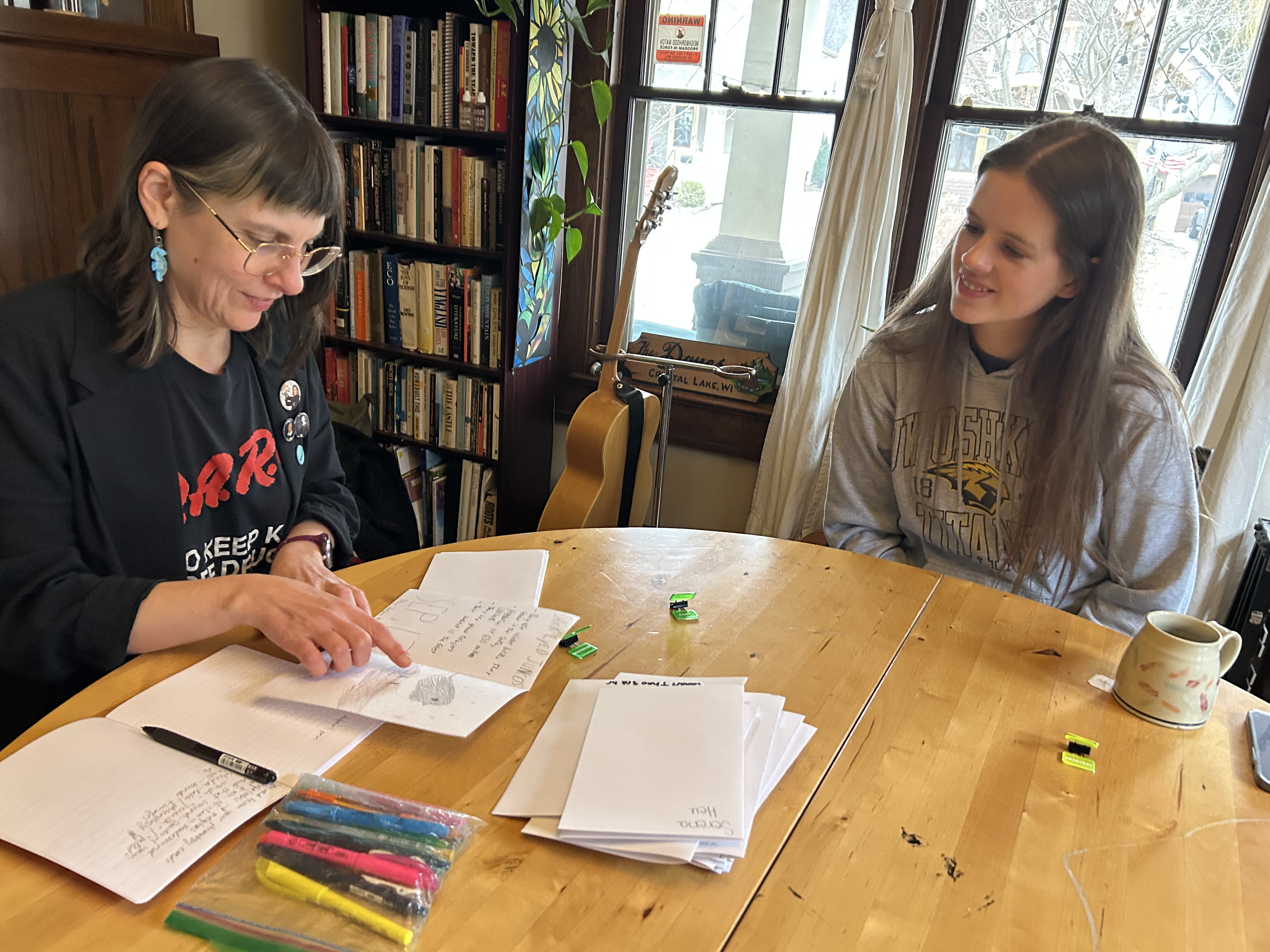
The class reads Range’s poem “A Skiff of Snow” in anticipation of her visit and an upcoming snowstorm. A veritable blizzard, the two-plus feet of accumulation cancel school for a few days and delay the workshop. With not much else to do, it’s a good opportunity to practice phenology; Joanna bikes till her hands freeze and observes the colors of the snow, skis and watches winter birds flit through the underbrush. Thanks to the calendar, she can now identify dark-eyed juncos.
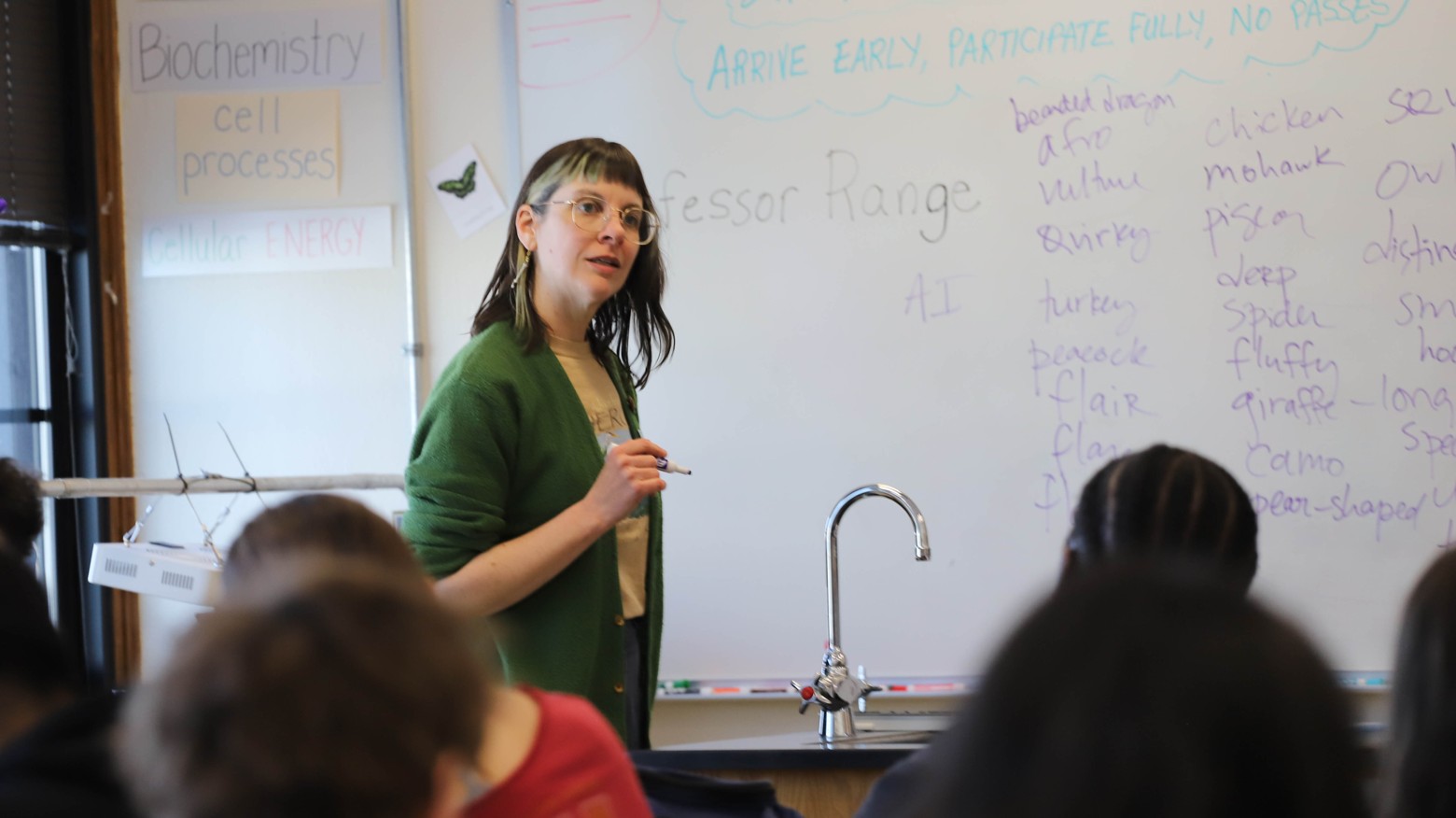
Workshop day finally arrives. Professor Range projects a picture of a ruffed grouse and prompts the students to share whatever words that come to mind. Brown, hooked beak, fluffy, proud. After compiling a list, she asks: what words would sound good with these? The kids shout out rhymes and other words that pop into their head. Now, pick three words that are most interesting to you. Fluffy, quirky, calm; rough, ruffed,gruff—the perfect seeds for a poem! Range explains the cinquain—a single-subject poem with five lines, generally following a 2-4-6-8-2 syllable pattern—and shares two of her own (about the golden-crowned kinglet and the wild turkey). With the structure as a guide, and their bird research and drawings as a starting point, “the students bend over their phenology cards and start to write.”
~
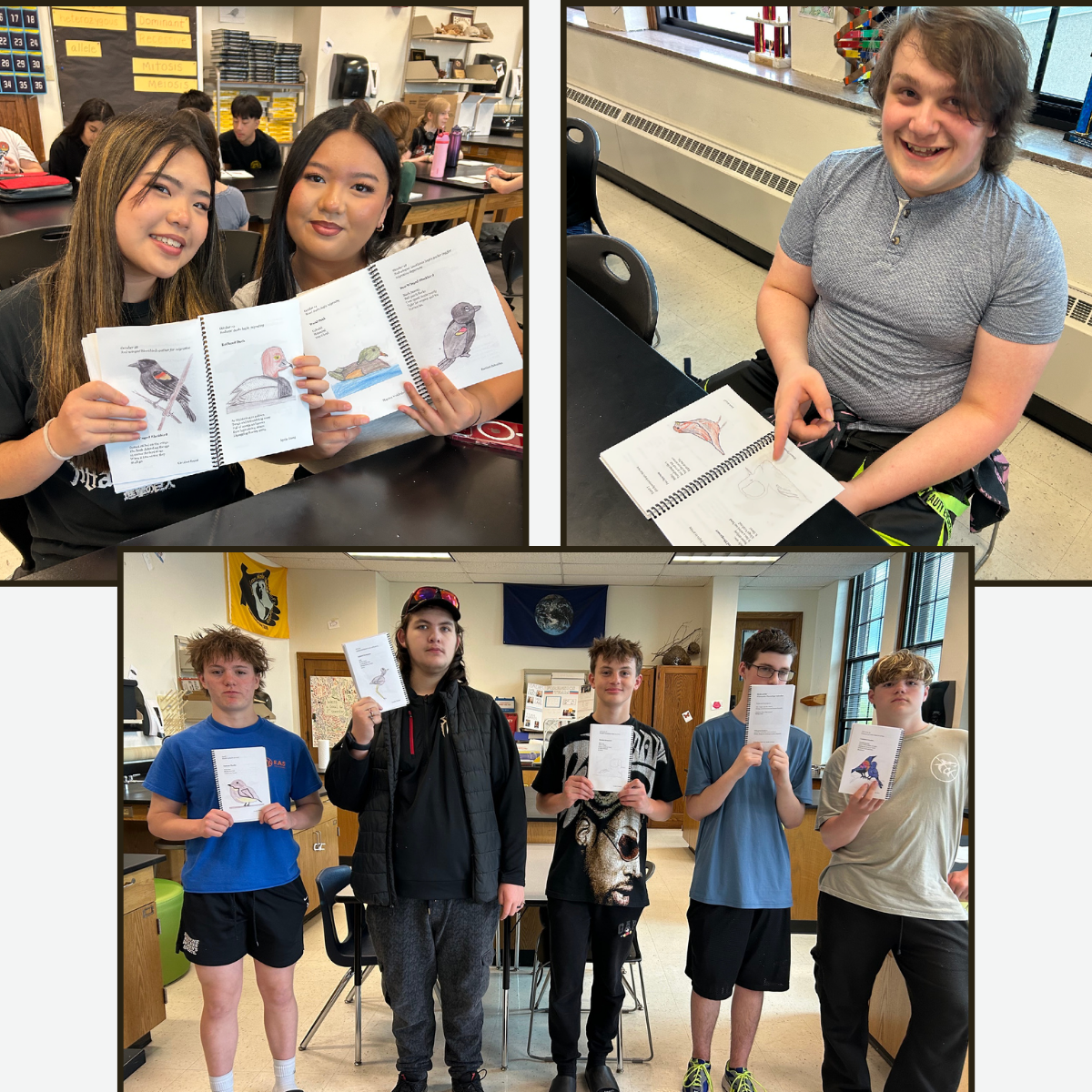
Joanna types up the poems, scans the drawings, compiles everything into a book and sends it to print. The proof comes back shortly after, and “flipping through it, it’s amazing to see how each bird is a direct expression of the student,” loose scribbles versus precise lines and shading, the flow or choppiness, rhyme and randomness of their cinquain poems matching each teen’s personality.
Sampling from "Birds of the Wisconsin Phenology Calendar." Also viewable at this link.
They plan a book release party for Earth Week, encouraging the students to come with family and friends. “This… is not only a phenology book, a bird book, a poetry book, an art book, it is a document of 109 students flocking together to notice our natural environment.” In short, it’s well worth celebrating!
On release day, a duet of flute players serenades as poems slide past on the library’s projector screen. Little by little, folks arrive: students (including ones from other classes and some who weren’t sure they’d make it), family, intrigued passersby. A professor-and-student duo from Lawrence University gives a short presentation on the practice of phenology, as well as a project that uses an app to track the seasonal changes of 10 trees on campus. Students read their poems, and their friends’ poems; the teachers urge guests to come on down and pick a piece to share—at least one does an overly dramatic rendition. Throughout the evening, attendees are invited to “write a sentence about a sign of spring,” and Joanna combines them all into a large group poem that she shares at the close of the program.
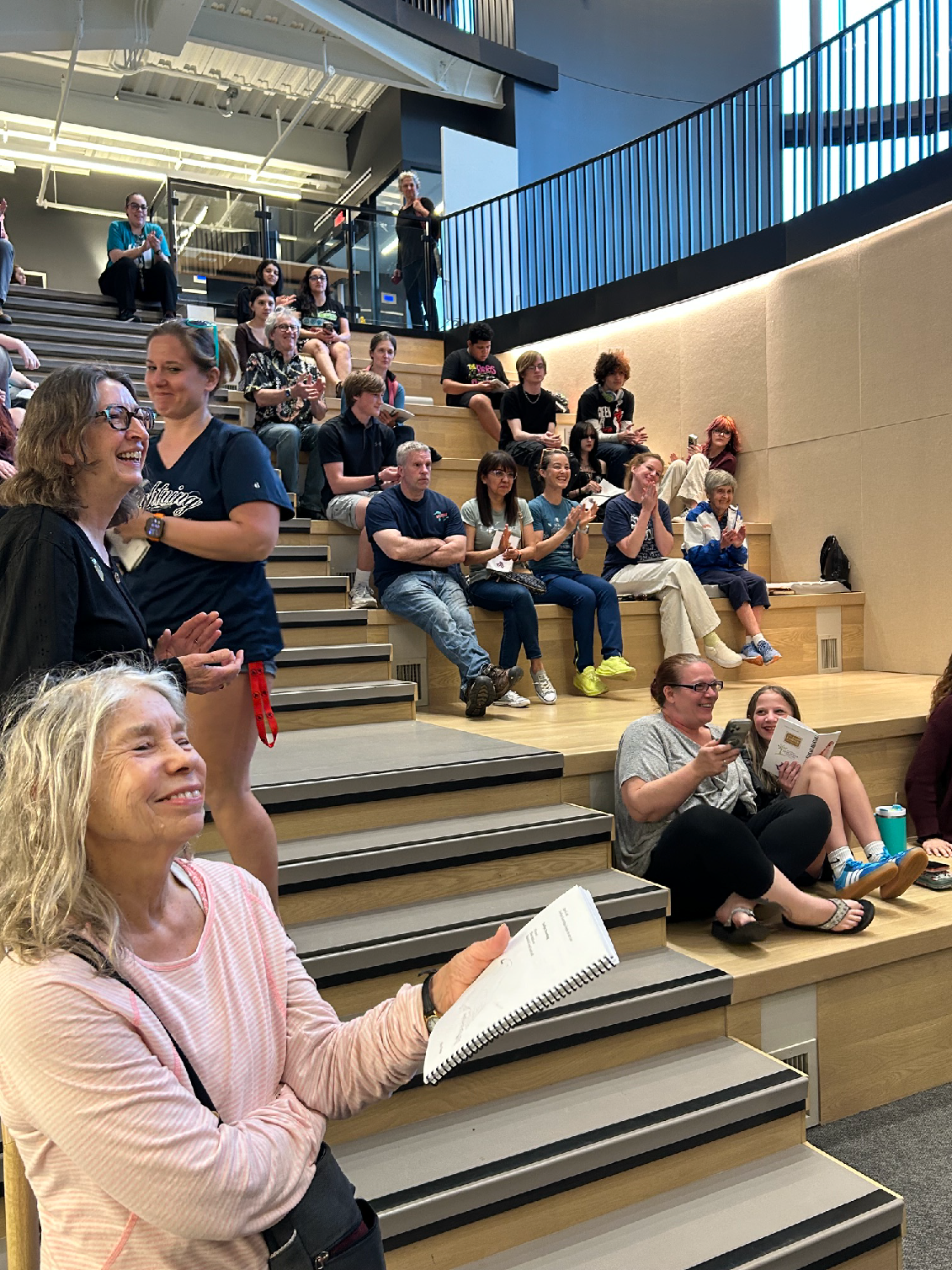
At the end, some audience members express their interest in getting copies of the book. Unfortunately, they only printed enough for their classes—but how wonderful that other people love them, too!
The next day, Joanna and Shannon pass the books out to their students and share how the release party went. They wrangle the kids to read the poems aloud, theirs or someone else’s, bringing some of the celebration’s live poetry magic back to the classroom. “In the aftermath,” Joanna writes, “we bask in the relief of getting through the whole messy process. We didn’t expect such a lovely book! Every page, a gem! .... Shannon and I agree: Let’s do it again next year. It will be easier now that we have a playbook.”
~
They end the year as they began it: with phenology. A slideshow of that month’s active organisms. A “spark week” sharing activities that pique the kids’ interest in nature and the outdoors ahead of summer break. An excerpt from the foreword to Amy Tan’s Backyard Bird Chronicles.
The teachers assign a final batch of phenology cards, to some complaints (why can’t we watch a movie like the other classes?), but “most of them dive right in.” They take the students outside, letting their curiosity run wild as they collect specimens to look at under the microscopes. Wild is the operative word, and “Shannon shares that she feels like it’s not worth it when they are acting like that” (end-of-the-year freshmen are certainly a handful), but won’t they remember this, “catching insects and looking at flowers under the microscope?” When asked to shout out all they’ve learned in biology that year, the list keeps growing. Won’t they remember that they read and wrote poems in science class, or one of the fun facts they learned about a species, or that they noticed the seasons in a new way?
Whether the kids do or not, the teachers will certainly remember the bird book and everything that led up to it. Joanna reads from it again on the last day. “I wonder if they think I’m making too big a deal out of [it]. Like, enough already with the bird book! But I can’t help myself. It’s so delightful!”
~
Phenology is here to stay: the teachers plan to use the calendar again in next year’s curriculum, and they’re also brainstorming a cross-disciplinary phenology project around a keystone bur oak tree on campus—bringing together science, English, and special education teachers, among others, to observe and document the tree’s changes with their students throughout the school year. Maybe there’ll be a tree book by next spring!
Joanna and Shannon have fully embraced the ethos of Leopold’s professorship, that of “putting the sciences and arts together for the purpose of understanding our environment,” and we’re excited to see what grows from the seeds they’ve planted.
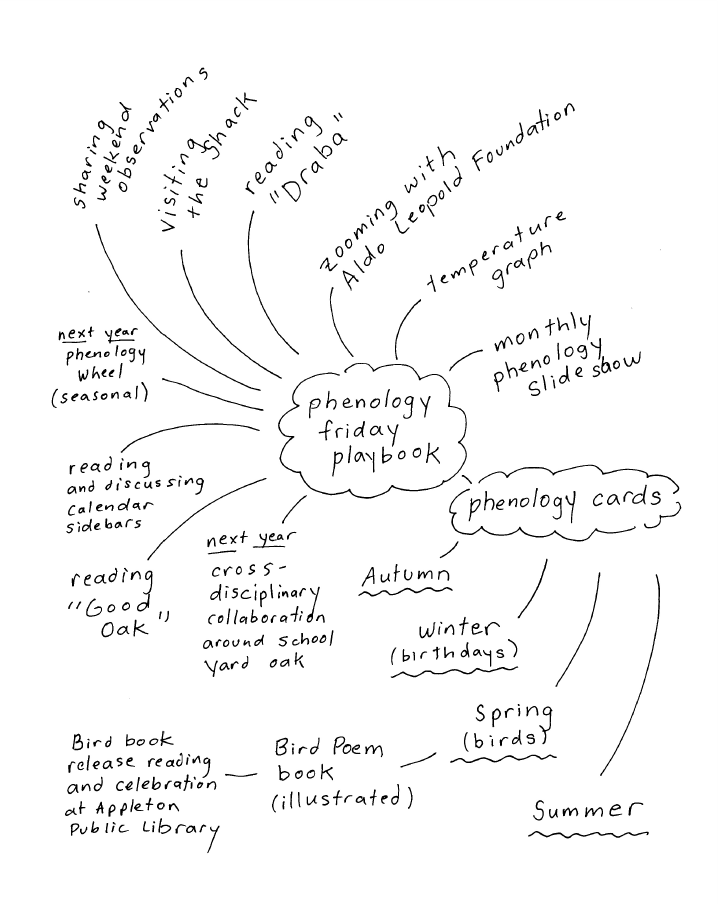
Joanna Dane is a special education teacher and Shannon Lang is a science teacher; together, they co-teach Biology and Environmental Studies at Appleton West High School in Wisconsin. Joanna is also a writer, artist, and improvisational musician.
~
Teachers interested in purchasing the phenology calendar, journal and planner, or A Sand County Almanac for use in their classroom may qualify for our educational pricing program. Learn more here.


.svg)

The Aldo Leopold Foundation was founded in 1982 with a mission to foster the Land Ethic® through the legacy of Aldo Leopold, awakening an ecological conscience in people throughout the world.
"Land Ethic®" is a registered service mark of the Aldo Leopold Foundation, to protect against egregious and/or profane use.


Stay connected through our down-to-earth e-news.