


Nature needs YOUR land ethic!
Stay connected through our down-to-earth e-news.

Fishes of "The Shack": The Ichthyofauna of the Leopold-Pines Conservation Area, Wisconsin was originally published in the Summer 2026 issue of American Currents, Vol 51. No. 3, and is republished with permission of the study authors, John Lyons, Michael J. Pauers, and Kimberly A. Kuber. Acknowledgements to the North American Native Fishes Association, which produces American Currents.
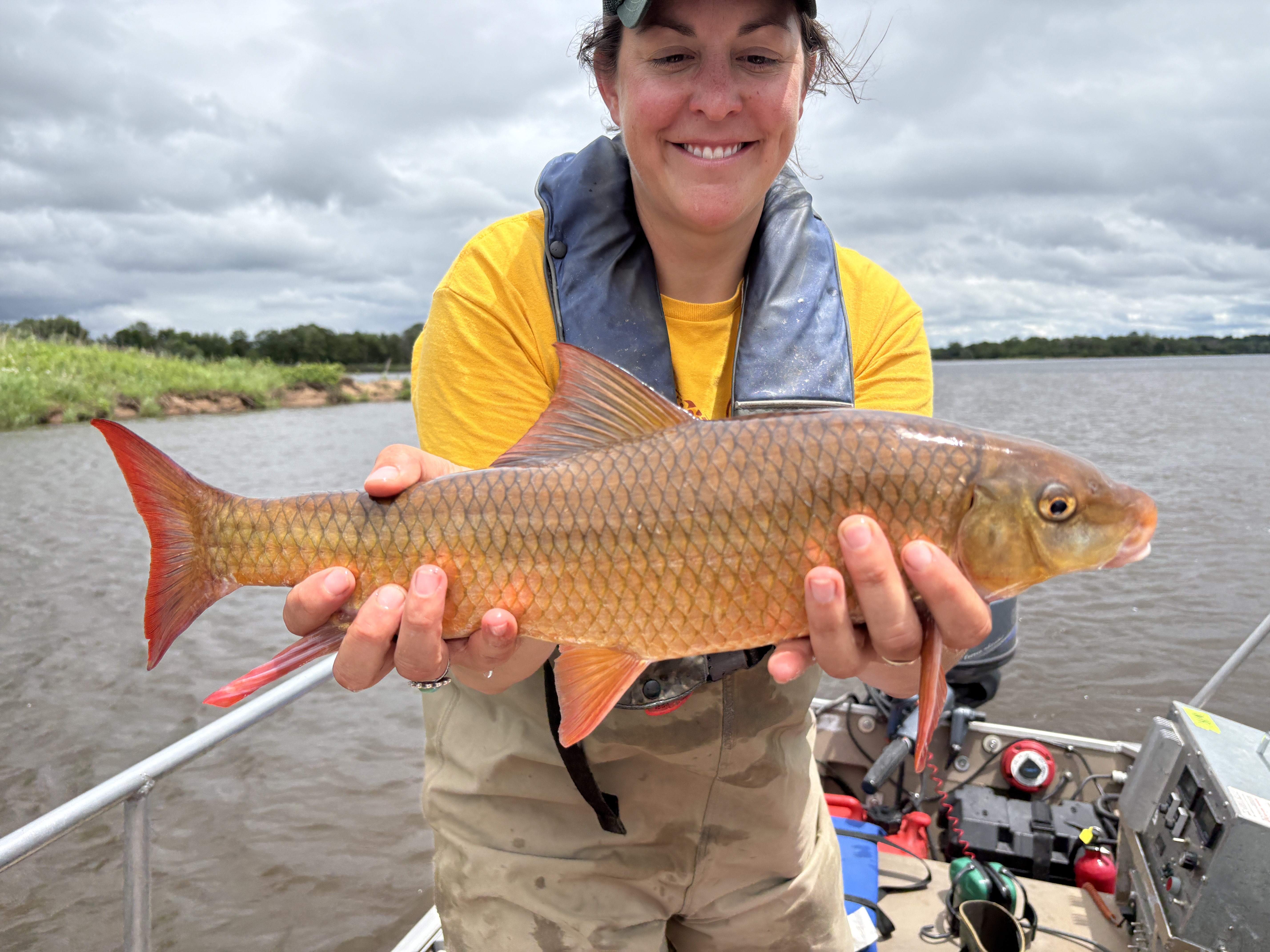
Header image: Researcher Kim Kuber holds a Shorthead Redhorse fish in a survey boat on the Wisconsin River.
The abandoned farm along the Wisconsin River that Aldo Leopold purchased in 1935, often referred to as the “The Shack” after the modified chicken coop he and his family stayed in while there, played an essential role in the development of Leopold’s land ethic environmental philosophy and is featured in his classic book A Sand County Almanac. The family regularly fished on the three permanent bodies of water on the property, the Wisconsin River, and two oxbow lakes, Chapman Lake and the Slough, and descriptions of their catches and the fine meals that resulted are scattered throughout the Leopold family’s writings. However, they never studied the fish they caught with the level of detail they gave to terrestrial plants and animals.
Until now there has never been a comprehensive summary of the fishes from The Shack. Beginning in 2017 and culminating with the Milwaukee Public Museum’s “Bioblitz” on June 27–28, 2025, we conducted fish surveys of The Shack and adjacent areas owned by the Aldo Leopold Foundation and Pines family, known and collectively managed as the Leopold-Pines Conservation Area (LPCA). In our sampling, we found 21 species of fish, 16 from the Wisconsin River and six from the two oxbow lakes. As is typical in healthy large Midwestern rivers, the most abundant species in the Wisconsin River are non-game species that are adapted for strong currents, particularly Emerald Shiner, Spotfin Shiner, Sand Shiner, and Shorthead Redhorse. The two oxbows currently contain species that thrive in heavily vegetated standing waters that occasionally experience low dissolved oxygen concentrations including Golden Shiner, Fathead Minnow, Central Mudminnow, and Pumpkinseed. The river has strong populations of several gamefish species such as Smallmouth Bass, Walleye, and Sauger, but the oxbows currently lack any species large enough to support a sport fishery.

We reviewed the Leopold family’s published writings and unpublished journals and photographs and found mention of 14 fish species, 12 from the river and seven from the oxbows. They caught Channel Catfish, White Bass, Smallmouth Bass, Walleye, and Sauger regularly in the Wisconsin River. Three gamefish species they fished for in the two oxbows, Northern Pike, Largemouth Bass, and Black Crappie, appear to have sharply declined or disappeared since their time, reflecting ecological changes over the last 75 years.
Based on our fish collections from the LPCA, information gleaned from the Leopold family’s writing and photographs, and numerous additional fish collections in the last 125 years from comparable habitats in the Wisconsin River upstream and downstream from the LPCA, we conclude that LPCA has a diverse fish fauna with 63 fish species currently or formerly present, 60 from the Wisconsin River and 11 from the two oxbows, with eight species in common. Four species—Shovelnose Sturgeon, Paddlefish, Longnose Gar, and Blue Sucker—have disappeared from the Wisconsin River at the LPCA. The1914 completion of the Prairie du Sac Dam, 35 miles downstream of the LPCA, eliminated the Shovelnose Sturgeon, Paddlefish, and Blue Sucker by blocking their essential migrations to and from the Mississippi River, 125 miles downstream. They could not complete their life cycle when restricted to the Wisconsin River above the dam. The Longnose Gar did not migrate to the Mississippi River, and the reasons for its demise are less clear. We speculate that the species may have been eliminated from the Wisconsin River above the Prairie du Sac Dam by overzealous and misguided control efforts in the early 1900s, prior to the Leopold’s time at the Shack.
“There are some who canlive without wild things, and some who cannot. These essays are the delights and dilemmas of one who cannot.” (Leopold 1949)
Thus begins A Sand County Almanac, one of the most important and beloved nature books of the20th century. It was written by the wildlife biologist and conservationist Aldo Leopold and published posthumously in 1949 after his untimely death in 1948. In the book, Leopold presented a series of thoughtful essays describing his experiences with the natural world and how they led him to the development of a new environmental philosophy, which he termed the land ethic.In this philosophy, he expands the concepts of morality,compassion, and obligation from human society to the “land,” which he defines broadly as “soil, water, plants, and animals” (Meine 2010), and he presents the oft-quoted idea that “A thing is right when it tends to preserve the integrity, stability, and beauty of the biotic community. It is wrong when it tends otherwise.” (Leopold 1949). The land ethic and the concept of biotic integrity are key underpinnings of many of the environmental protection legislation and management practices in the later 20th and early 21st centuries (Karr et al. 2022).
Many of the stories and ideas in A Sand County Almanac are place-based from a previously abandoned 150-acre farm along the Wisconsin River near the small city of Baraboo, Wisconsin, that Leopold purchased in 1935. He and his family repurposed an old chicken coop on the property as their family cabin, affectionately termed “The Shack” (Figure 1). They worked to restore the property back to ecological health, studied nature, and pursued outdoor sports, particularly hunting and fishing. The first half of A Sand County Almanac mainly describes events that occurred at or near The Shack, and the second half, which explains and promotes the land ethic,is informed by many of the observations Leopold made there.The Shack was precious to Leopold and his family, and al-though they lived over an hour away in Madison where he was a professor at the University of Wisconsin, they spent as much of their free time as possible visiting and enjoying it. Indeed, Leopold died near there in 1948 of a heart attack while helping a neighbor fight a brush fire.

After Aldo Leopold’s death, The Shack remained within the Leopold family. As adults, his five children, Starker, Luna, Nina, Carl, and Estella, scattered throughout the country to pursue their own careers, and each became a highly accomplished scientist and conservationist in their own right. But they returned to the Shack whenever they could. In 1982, they formed the Aldo Leopold Foundation (ALF) to preserve the Shack and surrounding lands in perpetuity. By this time, readers of the book and proponents of its philosophy had begun making visits to the Shack to see and experience the place where Leopold had developed the land ethic. The ALF embraced these visitors and built an international organization that has worked to maintain the Shack as it was in Leopold’s time, continued his family’s work to restore the surrounding lands, and supported environmental research, management, education, and outreach based on the land ethic. Cooperative agreements with federal and state government agencies, conservation non-profits, and especially the Pines family, who own substantial land adjacent to the Shack property, have expanded the area managed by the ALF to 4,000 acres (over six square miles), now termed the Leopold-Pines Conservation Area (LPCA) (Figure 2).
The Wisconsin River, which forms the northern border of the Shack property, and two oxbow lakes, are the three water bodies in the LPCA capable of supporting permanent fish populations. Leopold and his family fished these waters regularly and often ate their catch, and his books and his unpublished journal accounts describe the importance of their fishing outings for recreation and food while staying at the Shack. Although Leopold and his family carefully examined and described many of the plant and animal species and biological communities found around the Shack, neither they nor anyone else ever conducted any sort of examination of the fish community. The first scientific samplings targeting fish on the property did not take place until 2017 and 2019, and they were limited in scope. The only thorough fish survey occurred on June 27–28, 2025, when the Milwaukee Public Museum (MPM) held their annual Bioblitz at the LPCA. A Bioblitz is a 24-hour event in which scientists and the public try to identify as many different organisms as possible within a proscribed area, in this case the boundaries of the LPCA. We comprised the “fish team” for the MPM Bioblitz, and we used this opportunity to delve into the fishes within the LPCA. We combined our Bioblitz findings with the limited fish sampling within the LPCA done by John Lyons and colleagues in 2017 and 2019, information on the fishes caught by the Leopold family and guests that could be gleaned from their published writings and unpublished photos and field journals from 1935 through 1972, and far more extensive fish surveys of the Wisconsin River upstream and downstream of the LPCA from the 1900 up through the present. We used all this information to develop a comprehensive list of the fishes that are currently or were once found in and around the LPCA. Here we present the results from those collections and analyses, the first ever summary of the ichthyofauna of the LPCA.
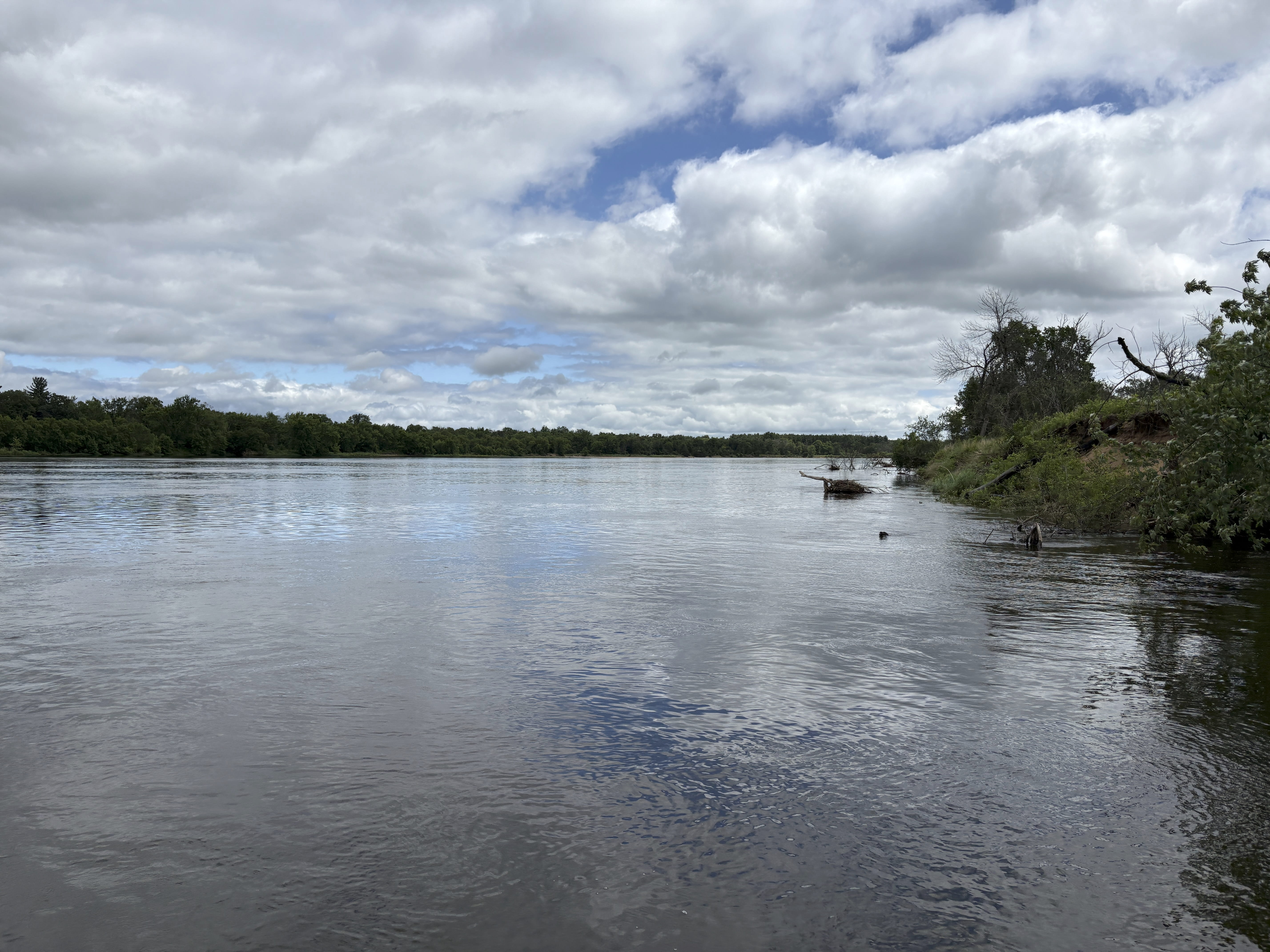
The aquatic habitats in the LPCA with permanent fish populations are the Wisconsin River (Figure 3), which forms the northern border of the area, and two oxbow lakes (old remnants of the former channels of the Wisconsin River) (Figure 4). The LPCA is in the Wisconsin River floodplain, and during high water, much of it can be inundated and temporarily have fish. However, during low water, only these three habitats are deep enough to support self-sustaining fish populations.
The Wisconsin River is a major tributary of the Mississippi River, flowing 417 miles from its source in Lac Vieux Desert on the Wisconsin-Michigan border to its mouth at the Mississippi River just south of Prairie du Chien, Wisconsin (Lyons 2005). The LPCA is about 125 miles upstream of the mouth, and at this point, the river is large. At Kilbourn Dam in Wisconsin Dells, a hydroelectric facility 12 miles upstream of the LPCA, the Wisconsin River has a basin area of about 8,140 square miles and a mean annual discharge of 6,950 cubic feet per second. The Wisconsin River in the LPCA is wide and relatively shallow and at normal summer flow has a mean width of about 1,200 feet, a mean depth of 1–2 feet, and a maximum depth of 6–9 feet. The water is somewhat stained from wetland drainage further upstream and has a large amount of drifting algae even during low flows such that it is usually difficult to see the bottom in more than a foot or so of water. The bottom substrate is primarily shifting sands with small patches of gravel. Hiding cover for fish is provided by numerous fallen trees along the banks and submerged logs in the channel, but rooted aquatic vegetation is largely absent. The shoreline is a mix of floodplain forest, shrubs, and meadows, and the LPCA side of the river is managed as a lowland swamp white oak savannah. Buildings and developed lands are limited to small areas on the north side of the river opposite the LPCA.
Although the Wisconsin River has a largely natural channel and shoreline in the LPCA and is one of the highest quality large rivers remaining in the Midwest (Lyons 2005), the river here has been modified by human activities over the last 150 years. The most significant impacts have come from dams. The Prairie du Sac Dam, a hydroelectric facility about 35 miles downstream and completed in 1914, is impassable to fish moving upstream and has blocked and eliminated migratory species from the LPCA (Lyons 1993, 2005; Lyons et al. 2001). The Kilbourn Dam, completed in 1909, also blocks upstream fish movements. It and 25 additional dams further upstream have substantially reduced seasonal variation in river flows. Large floods have been dampened by reservoir storage, and drought flows have been increased by reservoir releases. These upstream dams also impede natural sediment movements in the river and have led to increases in bank and channel erosion in the LPCA. The next dam above Kilbourn, Castle Rock, a hydroelectric facility 35 miles upstream, has daily “peaking” water releases during periods of high electrical demand, which leads to substantial daily flow fluctuations of several hundred cubic feet per second at the LPCA, especially during the summer. These variations in flow can rapidly dewater shallow areas and then reflood them a few hours later. Despite the reduction in high flows caused by the dams, the river immediately below the LPCA has levees on both sides of the channel for over 12 miles to prevent flooding of the city of Portage and to break a former natural high-water connection between the Wisconsin River and the Fox River, which is a tributary of Lake Michigan and thus in a completely different basin, the Great Lakes (Lyons et al. 2024). These levees prevent floods from spreading out into the floodplain downstream of the LPCA but as a result back-up the river and increase flooding within the LPCA.
Water pollution also impacts the Wisconsin River at the LPCA. Historically, cities, manufacturing, and agriculture located further upstream produced large amounts of untreated waste and nutrients and dissolved solids that degraded water quality in the LPCA (Coble 1982; Lyons 1993; Lyons et al. 2001; Lyons 2005). Since the 1970s, massive investments in pollution control have greatly decreased the effects of city sewage and manufacturing waste, but contaminants remain in sediments in the river, especially PCBs, and they have become concentrated in some fish species, limiting the amount of fish that can be safely eaten (Lyons 2005). Reducing runoff from agriculture has proven much more difficult, and excessive fertilizer, manure, and soil still enter the river during every rainstorm or snowmelt event. This has led to eutrophication and annual noxious algae blooms in the upstream reservoirs and lowered water clarity and depressed water quality in the river along the LPCA (Weigel and Roberston 2007; Weigel and Dimick 2011).
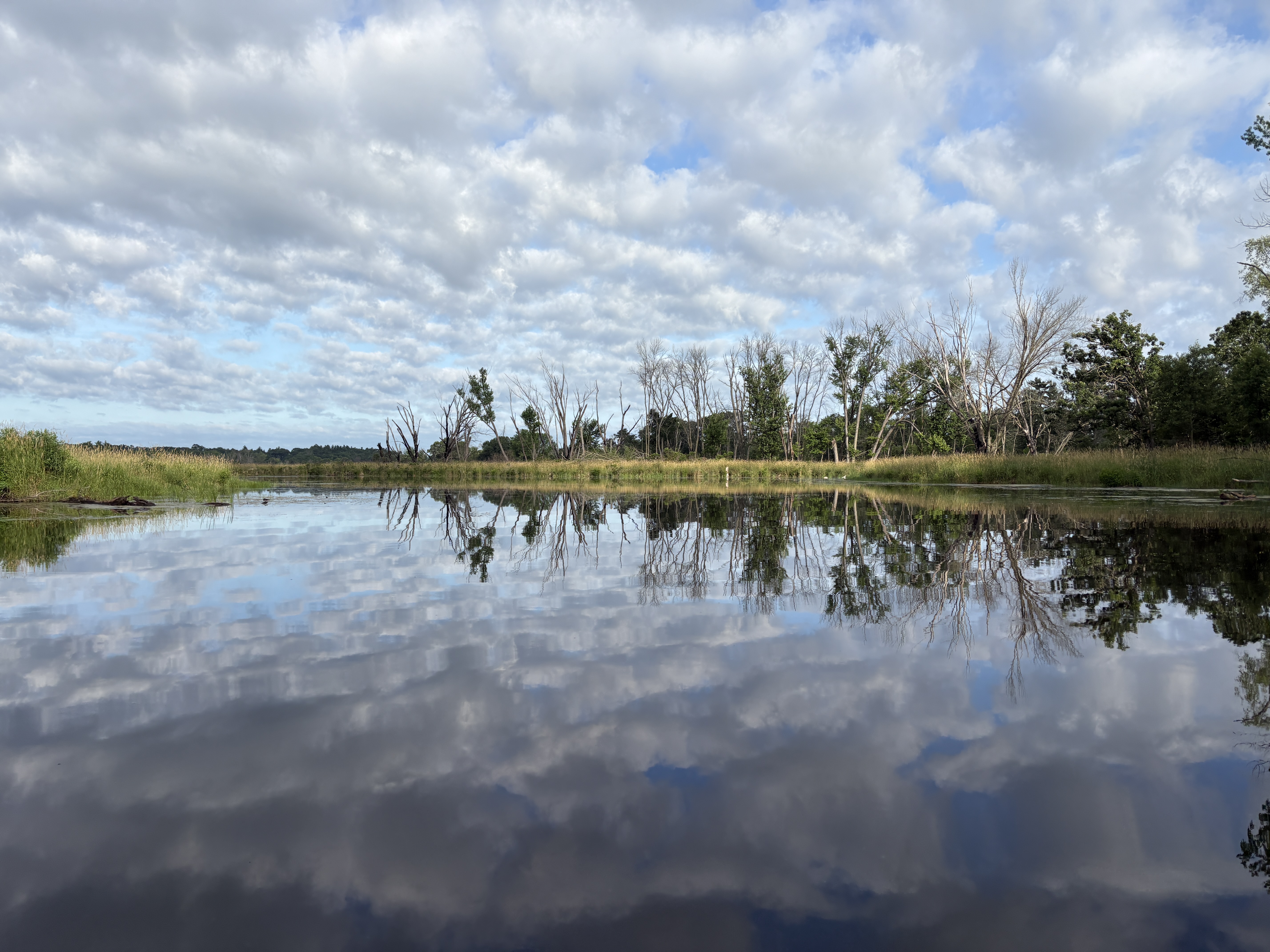
The two oxbow lakes, the Slough and Chapman Lake, were once part of the channel of the Wisconsin River but became separated from the river at normal flows as the river channel naturally migrated northeastward over the centuries. They are now classic oxbows, relatively long and thin and sinuous like a river channel. The Slough is currently about 800 feet southwest of the river and Chapman Lake about 2100 feet. During high-water events, the Slough temporarily receives flow from the river, but Chapman Lake is only reconnected during the largest floods. The Slough is about 1 acre in surface area and has a maximum depth of about 5–6 feet. It receives some spring seepage from a small bluff along its southwest shore. It is surrounded by thick shrubs and trees, heavily shaded, and full of fallen logs and branches. During summer, the water appears somewhat stagnant. Chapman Lake is about 4 acres in surface area and at least 8 feet deep. It is open and surrounded by marshland. The water is clear, and submerged, floating, and emergent aquatic vegetation is abundant.
Our summary of the ichthyofauna of the LPCA is based on three types of information: (1) our fish collections from the LPCA in 2017, 2019, and the 2025 Bioblitz, (2) published and unpublished writings and photographs from the Leopold family archives, and (3) fish collection data from similar habitats in the Wisconsin River upstream and downstream of the LPCA.
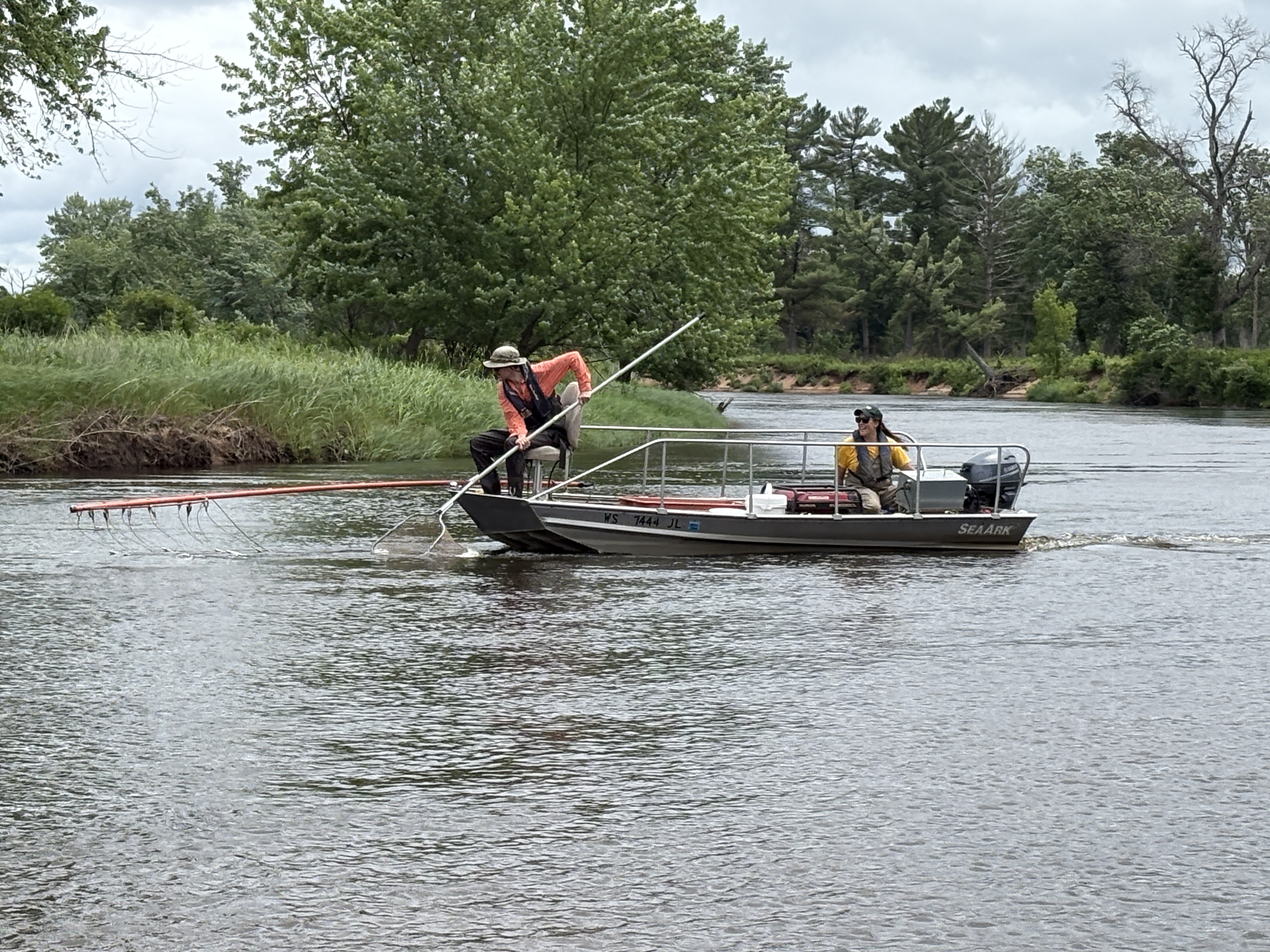
We collected fish from the Wisconsin River in 2017 and 2025 (Figure 5), the Slough in 2019, and Chapman Lake in 2019 and 2025 (Figure 6). The exact locations, sampling dates, and techniques are in Table 1. We identified and counted all the fish we encountered and photographed examples of most species. We released nearly all fish unharmed after processing, but we euthanized two Quillbacks and three Highfin Carpsuckers from the Wisconsin River in 2025 and then preserved and deposited them in the fish collection of the University of Wisconsin Zoological Museum.

To determine the fish species encountered by the Leopolds at and around the Shack, we surveyed publications that portrayed their activities there (Leopold 1949; Meine 2010; Leopold 2016; Hunt 2025), and we did keyword searches (e.g., ”minnow,” “pike,” “bass,” “crappie,” “walleye”) on the voluminous digitized field notebooks and photographs available from the Aldo Leopold archives at the University of Wisconsin-Madison Steenbock Library that cover 1935–1972 (images archive: https://search.library.wisc.edu/search/digital?filter%5Bfacets%5D%5Bcollections_facet~Aldo+Leopold+Collection%5D=yes&q=fish, field notebooks and journals: https://search.library.wisc.edu/digital/A4H7W7SOLVJ6YI8I/search?q=fish&filter%5Bfacets%5D%5Bvolume_facet%7E3.+Diaries+and+Journals%3A+Shack+Journals%2C+1935–1948%5D=yes). For each fish notation we found, we noted the species, location (Wisconsin River, the Slough, or Chapman Lake), and the year. The Leopolds sometimes employed fish names no longer in wide use (e.g., “Mud Cat” for Flathead Catfish), which we converted into modern common names, and they often used non-specific names for certain groups of fishes (e.g., “Bass”), which we assigned to the most likely species based on the habitat from which it came.
To create a more complete picture of the fish species that currently occur or were once found in the Wisconsin River along the LPCA, we summarized published and unpublished data on all fish collections from 1900–2025 from the Wisconsin River upstream and downstream of the LPCA from the Kilbourn Dam in Wisconsin Dells (~12 miles upstream) to the city of Portage (~12 miles downstream). Including the 3 miles along the LPCA, this represents about 27 miles of river. We examined relevant published references (Greene 1935; Becker 1983; Fago 1992; Lyons 1993; 2005; Lyons et al. 2000, 2001; Lyons and Schmidt 2022) and unpublished databases from the Wisconsin Department of Natural Resources and the University of Wisconsin Zoological Museum. We included only species that would likely be found in main-channel flowing-water habitats like those along the LPCA, and we excluded species typically limited to lakes or off-channel habitats such as connected sloughs and backwaters, which do not occur in the Wisconsin River in the LPCA.

In our 2017–2025 surveys, we collected 21 species of fish: 16 from the Wisconsin River, 3 from the Slough, and 5 from Chapman Lake (Table 2). The Slough had two species in common with Chapman Lake (Golden Shiner and Central Mudminnow) and one in common with the Wisconsin River (Bluegill), but Chapman Lake and the Wisconsin River shared no species. The most common species encountered were Pumpkinseed in Chapman Lake (N=317; Figure 7), Golden Shiner in Chapman Lake (N=38) and the Slough (N=17; Figure 8), and Emerald Shiner (N=40; Figure 9), Shorthead Redhorse (N=25; Figure 10), Spotfin Shiner (N=24; Figure 11), and Sand Shiner (N=16) in the Wisconsin River. The species we found in Chapman Lake and the Slough were small and adapted to heavily vegetated standing water that occasionally experiences low dissolved oxygen concentrations (Becker 1983; Lyons 1996; Lyons et al. 2000; Lyons and Schmidt 2022). Neither oxbow yielded any fish that could support a quality fishery. Although Pumpkinseeds are classified as gamefish, none of the many individuals we caught in Chapman Lake were larger than 3.5 inches in length, too small to appeal to anglers. In contrast, the Wisconsin River was dominated by species adapted for life in the strong currents of large rivers (Lyons et al. 2001), and our sampling yielded six gamefish species big enough for fishing, Flathead Catfish, Northern Pike, Bluegill, Smallmouth Bass, Walleye, and Sauger. Of note, we caught a Flathead Catfish estimated to be 35 pounds (too large to bring into the boat for a measurement) and a Walleye of 27.5 inches and 7.7 pounds (Figure 12).

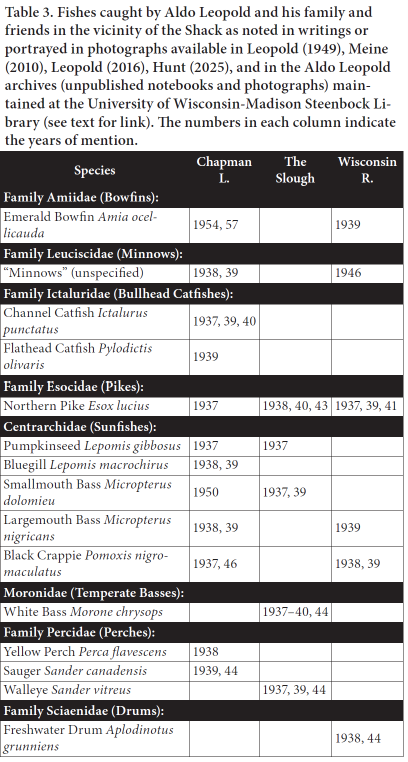
From our review of the Leopold family’s writings and photographs, we identified 14 fish species that they encountered at and around the Shack, seven from Chapman Lake, two from the Slough, and 12 from the Wisconsin River (Table 3). Northern Pike was the only species noted from all three places. Chapman Lake had two species in common with the Slough (Northern Pike, Largemouth Bass) and five with the Wisconsin River (Emerald Bowfin, Northern Pike, Pumpkinseed, Smallmouth Bass, Black Crappie), but the Wisconsin River shared only one with the Slough (Northern Pike). Interestingly, the Leopolds regularly collected “minnows” from all three locations for bait. Presumably this name encompassed several species, but despite the Leopold family’s keen interest in terrestrial animals and plants, we can find only one indication that they ever identified the kind of minnows they caught. In 1938, the bait “minnows” were said to be comprised mostly of small Yellow Perch. This suggests that the Leopolds used the term “minnow” for any small fish rather than limiting it to the Minnow family (Leuciscidae), which was a surprise to us given their attention to taxonomic detail and accurate identification for the organisms they encountered on land.
Based on the archives (Table 3), the Leopolds clearly enjoyed fishing on their property and eating their catch. They were interested in making fishing better, and in June 1938 they arranged to have 1,000 one-inch Largemouth Bass stocked in Chapman Lake and the Slough (unpublished field notes). Despite this effort, Estella (Aldo’s daughter) described the situation in Chapman Lake as “not good fishing but occasionally nice Bluegills” (p. 12; Leopold 2016). They named a deep spot on the western end of the Slough the “pike hole” (Hunt 2025), presumably because it held Northern Pike, and the family fished there regularly, but we could find no accounts mentioning success. The family had better luck on the Wisconsin River, and we found many notations and a few photos of catches of Channel Catfish, Flathead Catfish, Northern Pike, White Bass, Smallmouth Bass, Black Crappie, Walleye, Sauger, and Freshwater Drum (unpublished field notes and photos; Figure 13). The Leopolds sometimes commented on the taste of their fish, such as this 1944 unpublished field notebook entry (p. 206): “After cooking, we found both [Walleye and Sauger] very mushy and distinctly inferior to the stripers [White Bass]. Probable rule of practice: wall-eyes and sandpike [Sauger] are barely edible between June and October.”

The Leopold family’s fishing experiences and catches on the two oxbows contrast sharply with the results of our sampling. They mention only two species that we found, Pumpkinseed and Bluegill. We believe that the unspecified “minnows” they used for bait likely encompassed some of the smaller fish species we collected, but our failure to find any of the larger species they regularly fished for— Northern Pike, Largemouth Bass, and Black Crappie—indicates substantial changes in Chapman Lake and the Slough since the 1940s. In the Slough, the loss of larger fish appears to be the result of habitat changes. The vegetation along the shore of the Slough is now very different than it was 75 years ago. In Aldo Leopold’s time, the shoreline and surface of the Slough were relatively open and received substantial sun, and the family could easily boat and fish there. The presence of the “pike hole” suggests that the Slough was also deeper, and the water was not stagnant like it is now. At present, because of natural succession, the Slough is surrounded by thick forest and shrubs, heavily shaded, and filled with downed trees. The “pike hole” appears to have filled in. Foot access is difficult and boating nearly impossible. The habitat no longer looks suitable for the Northern Pike and Largemouth Bass that the Leopolds used to target, neither of which we caught.
Habitat changes in Chapman Lake are less obvious. The lake is currently open to the sun with minimal shade, is surrounded by cattails and other marsh vegetation, and has clear water full of aquatic plants. As far as we can reconstruct from written descriptions and photos, it was similar in the 1930s and 1940s. In those days the shoreline was also open and marshy, the water was clear, and aquatic vegetation was common. But the Northern Pike, Bluegill, Largemouth Bass, and Black Crappie that the Leopolds fished for appear to have disappeared or at best become quite scarce over the last 75 years. Why this change in the fish community took place is uncertain. It is possible that in some of the years since then the decay of the abundant aquatic vegetation during the winter under the ice used up all the dissolved oxygen in the water and caused winterkills that led to the demise of the larger gamefish, a common phenomenon in small shallow lakes in Wisconsin (Tonn and Magnuson 1982). The species that remain now are particularly well adapted to low oxygen (Magnuson et al. 1985), and ponds that winterkill regularly sometimes have abundant small Pumpkinseed with no large individuals, just as we found (Fox and Keast 1990). But given the habitat conditions in the 1930s and 1940s, it seems as though winterkills also would have happened then, maybe even more frequently, since the winters were generally longer and harsher. So how did the larger gamefish persist during the Leopold family’s time? We know they stocked Largemouth Bass (perhaps to replace losses due to winterkill?), and maybe they also added Northern Pike, Bluegill, and Black Crappie. But we have no evidence of this from the archives. The fish shift in Chapman Lake remains a mystery.
Although our surveys from 2017–2025 represent the first attempt to sample scientifically the fishes of the LPCA, these surveys were too limited in scope and effort to fully characterize the fish fauna of the Wisconsin River. Not surprisingly, the much more extensive surveys conducted upstream and downstream of the LPCA found far more species than we did. All told, these surveys encountered 60 species, 44 more than us (Table 2, 4). Twenty-nine of these 44 were uncommon and four had been extirpated by the 1950s; so, our survey missed 11 common species. The relatively high diversity of fishes present is indicative of the generally good conditions found in the Wisconsin River at the LPCA.
When we combine our surveys, the catches of the Leopolds, and the results of fish surveys upstream and downstream of the LPCA since 1900, we conclude that 63 fish species are currently, or once were found, in the LPCA (Table 4). Sixty species are or were from the Wisconsin River and 11 from the two oxbows, with eight species known from both habitats. In the two oxbows, we classified six species as common and five as uncommon, although three of these, Northern Pike, Largemouth Bass, and Black Crappie, may now be extirpated. For the Wisconsin River, we classified 25 species as common, 31 as uncommon, and four—Shovelnose Sturgeon, Paddlefish, Longnose Gar, and Blue Sucker—as extirpated.
The four extirpated species disappeared after completion of the Prairie du Sac Dam in 1914, which blocked migration by fishes in the LPCA to and from the Mississippi River, about 125 miles downstream. Shovelnose Sturgeon, Paddlefish, and Blue Sucker are known to move regularly between the Wisconsin and Mississippi rivers, and they spawn and spend at least part of their adult life in the Wisconsin River but appear to need the extensive backwaters and sloughs of the Mississippi River as nursery habitat for their young (Lyons 1993; Zigler et al. 2003; Lyons et al. 2016; Pracheil et al. 2019). Thus, when the Prairie du Sac Dam prevented movement to and from the Mississippi River, these three species disappeared from the LPCA.
The loss of the Longnose Gar from the LPCA is puzzling. This species does not make long-distance migrations to the Mississippi River, and it should be able to complete its life cycle in the Wisconsin River upstream of the Prairie du Sac Dam, especially in the impoundment that was formed, Lake Wisconsin. The Longnose Gar is tolerant of low dissolved oxygen and many types of pollution and lives in a wide range of slow-moving aquatic environments, and thus habitat or water quality changes do not satisfactorily explain its demise from the LPCA. One possibility is that the species was persecuted out of existence by people. Gar species were viewed as undesirable until relatively recently, and they were killed on sight and discarded by many anglers and deliberately eradicated by fisheries professionals during much of the 1800s and 1900s under the mistaken belief that they suppressed gamefish populations (Burr 1931; Rypel et al. 2021). Gar species have a low population replacement rate and are thus vulnerable to excessive harvest (Molinaro et al 2024). If few Longnose Gar were initially present, which is plausible as southern Wisconsin is near the northern limit of the range of the species, human removals may have been enough to eliminate the population from the LPCA. And once the Prairie du Sac Dam was in place, there was no way for Longnose Gar from further downstream to recolonize. But we
have no information on what actually happened on the Wisconsin River in the LPCA in the early 1900s, so this is all speculation.
In conclusion, the fish fauna of the LPCA is diverse and generally indicative of a healthy environment. The 63 species documented have a wide range of life histories, habitat preferences, and sizes. Several are valuable gamefishes. However, despite the long history of ecological restoration of the property and the current generally good quality of the aquatic habitats there, three species may have disappeared from the two oxbow lakes since Leopold’s time, and another four have vanished from the Wisconsin River since the early 1900s. The oxbow fish losses may be attributed to natural ecological processes, but the Wisconsin River eliminations are likely due to human actions over 100 years ago and occurred before the Leopolds began using the Shack.
We thank Steve Swenson and Arik Duhr from the Aldo Leopold Foundation for providing access to the Wisconsin River for our electroshocking boat during the Bioblitz, Julia Colby from the Milwaukee Public Museum for organizing and overseeing the Bioblitz, and Seth McGee, University of Wisconsin-Madison for assistance accessing the Leopold archives. Brian Weigel and Steve Swenson helped with sampling in 2017, and Dave Marshall, Sue Marcquenski, and Carl Cotter participated in 2019. Steve Swenson made helpful comments on a previous draft of this report.
John Lyons is the Curator of Fishes at the University of Wisconsin Zoological Museum. He is a former Wisconsin Department of Natural Resources Fisheries Research Scientist who has been working on Wisconsin fishes since 1979. He received his PhD and MS in Zoology from the University of Wisconsin-Madison and his BS in Biology from Union College, Schenectady, NY.
Michael J. Pauers is the Adjunct Curator of Fishes at the Milwaukee Public Museum, and an Assistant Professor of Biology at the University of Wisconsin-Whitewater. He earned his Ph.D. in 2004, and a B.S. in 1997. His specialty is the evolution, behavior, and taxonomy of cichlid fishes from the African Great lakes, but he also has significant experience with the fishes of Wisconsin.
Kimberly Kuber is a Water Quality Biologist with the Wisconsin Department of Natural Resources. She has enjoyed working with fishes in Wisconsin’s streams and rivers since 2013. She received her MS in Fish, Wildlife, and Conservation Biology from Colorado State University and her BS in Water Resources from University of Wisconsin-Stevens Point.


.svg)

The Aldo Leopold Foundation was founded in 1982 with a mission to foster the Land Ethic® through the legacy of Aldo Leopold, awakening an ecological conscience in people throughout the world.
"Land Ethic®" is a registered service mark of the Aldo Leopold Foundation, to protect against egregious and/or profane use.


Stay connected through our down-to-earth e-news.